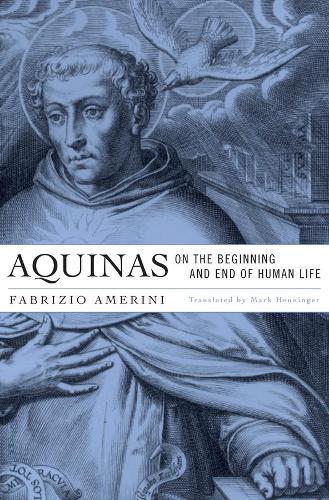
Книга Aquinas on the Beginning and End of Human Life
In contemporary discussions of abortion, both sides argue well-worn positions, particularly concerning the question, When does human life begin? Though often invoked by the Catholic Church for support, Thomas Aquinas in fact held that human life begins after conception, not at the moment of union. But his overall thinking on questions of how humans come into being, and cease to be, is more subtle than either side in this polarized debate imagines. Fabrizio Amerini—an internationally-renowned scholar of medieval philosophy—does justice to Aquinas’ views on these controversial issues.
Some pro-life proponents hold that Aquinas’ position is simply due to faulty biological knowledge, and if he knew what we know today about embryology, he would agree that human life begins at conception. Others argue that nothing Aquinas could learn from modern biology would have changed his mind. Amerini follows the twists and turns of Aquinas’ thinking to reach a nuanced and detailed solution in the final chapters that will unsettle familiar assumptions and arguments.
Systematically examining all the pertinent texts and placing each in historical context, Amerini provides an accurate reconstruction of Aquinas’ account of the beginning and end of human life and assesses its bioethical implications for today. This major contribution is available to an English-speaking audience through translation by Mark Henninger, himself a noted scholar of medieval philosophy.
"Erudite, thoughtful, [and] carefully translated… Amerini exposes the ‘tensions’ and ‘vacillations’ in Aquinas’s abstruse accounts of human embryogenesis. But their main point is clear: the inseminating male initiates a process that, while it leads to the conception of a pre-human uterine animal, does not actually generate another human being." - America
"What makes the book, I think, a fascinating read, is Amerini’s detailed analysis of texts that Thomas wrote throughout his career, showing how his thoughts on the topic evolved and were refined. In that sense, I think anyone interested in history, especially the history of philosophy and science, would be fascinated at this look inside the world of a medieval philosopher on one very particular topic." - Forbes
"Because Aquinas’s teachings are authoritative for Catholic theology, this volume by Amerini explores Aquinas’s account of life’s beginning and end. The author notes Aquinas’s inconsistency and changing views. He argues that the Thomistic account does not allow one to claim that an embryo is a human being at the moment of conception, since Aquinas believes humans require faculties of will and reason. Still, scholars need to look at contemporary scientific accounts of growth and development to see how they may or may not harmonize with specific teachings. Students of theology and bioethics will find this study elucidating, especially since it shows the promise and pitfalls of attempting to use classical theological sources to construct positions for contemporary Christian ethics. Students interested in Thomistic thought, theological bioethics, and Catholic moral theology will find this closely argued work worthwhile and illuminating reading." - Choice