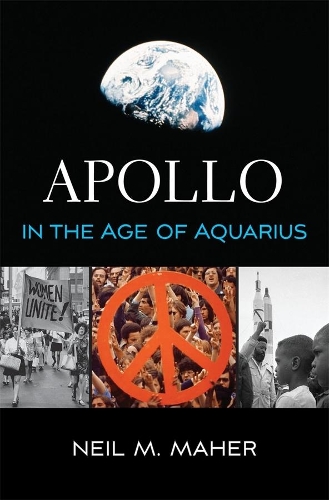
Книга Apollo in the Age of Aquarius
Winner of the Eugene M. Emme Astronautical Literature Award
A Bloomberg View Must-Read Book of the Year
A Choice Outstanding Academic Title of the Year
“A substance-rich, original on every page exploration of how the space program interacted with the environmental movement, and also with the peace and ‘Whole Earth’ movements of the 1960s.”
—Tyler Cowen, Marginal Revolution
The summer of 1969 saw astronauts land on the moon for the first time and hippie hordes descend on Woodstock. This lively and original account of the space race makes the case that the conjunction of these two era-defining events was not entirely coincidental.
With its lavishly funded mandate to put a man on the moon, the Apollo mission promised to reinvigorate a country that had lost its way. But a new breed of activists denounced it as a colossal waste of resources needed to solve pressing problems at home. Neil Maher reveals that there were actually unexpected synergies between the space program and the budding environmental, feminist and civil rights movements as photos from space galvanized environmentalists, women challenged the astronauts’ boys club and NASA’s engineers helped tackle inner city housing problems. Against a backdrop of Saturn V moonshots and Neil Armstrong’s giant leap for mankind, Apollo in the Age of Aquarius brings the cultural politics of the space race back down to planet Earth.
“As a child in the 1960s, I was aware of both NASA’s achievements and social unrest, but unaware of the clashes between those two historical currents. Maher [captures] the maelstrom of the 1960s and 1970s as it collided with NASA’s program for human spaceflight.”
—George Zamka, Colonel USMC (Ret.) and former NASA astronaut
“NASA and Woodstock may now seem polarized, but this illuminating, original chronicle…traces multiple crosscurrents between them.”
—Nature
"Neil M. Maher’s Apollo in the Age of Aquarius succeeds admirably in weaving a seamless web of technological, economic, political, social and cultural strands and their multiple, intended and unintended consequences." - Times Literary Supplement
"I very much enjoyed this book. Think of it as a substance-rich, original on every page exploration of how the space program interacted with the environmental movement, and also with the peace and ‘Whole Earth’ movements of the 1960s. Most of all it is a social history of technology." - Marginal Revolution
"On 20 July 1969, men landed on the Moon; back on Earth, the United States was gripped by sociopolitical convulsions. NASA and Woodstock may now seem polarized, but in this illuminating, original chronicle, historian Neil Maher traces multiple crosscurrents between them. The impact of the ‘Blue Marble’ image of Earth on environmental policy is famous. Less so is how the costs of the Apollo program enraged inner-city activists—and how NASA duly deployed a crack team of aeronautics experts to solve practical housing issues for poor African Americans." - Nature
"In Apollo in the Age of Aquarius, Maher frames a meticulously researched story of NASA’s interaction with the social and political movements of the ’60s…A reader with an interest in NASA history will find a new perspective in this book with a focus on the space program’s interactions with the civil rights movement, the women’s movement, environmentalists, and the counterculture. Those with an interest in the cultural history of the ’60s will find an even more rewarding read, as Maher offers depth and breadth in his writing." - PopMatters
"Maher contrasts the culture of the 1960–70s NASA leadership and its focus on the space race with counterculture leaders’ focus on the issues of poverty, housing, war, nature and environment, and sexism and feminism…[An] excellent work." - Choice