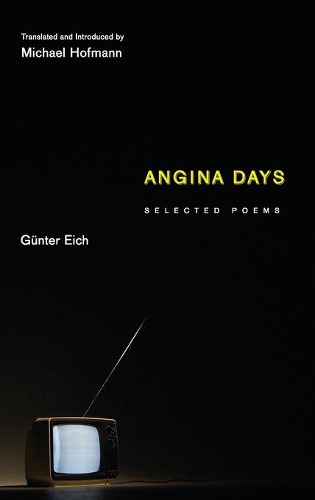
Книга Angina Days: Selected Poems
Of the three postwar writers whose work seems most clearly to answer to Adorno's sense that no poetry can be written after the Holocaust, it is Eich (Beckett and Celan are the others) whose refusal of rhetoric is most thorough, with the result that the speaker--the authorial presence--whoever it is who would have persuaded, blamed, or badgered us, seems to have vanished into thin air, leaving nothing to come between ourselves and the pure experience offered by the poems. -- Belle Randall, poetry editor, "Common Knowledge" This is an extremely important book. Gunter Eich is a highly significant German poet and Michael Hofmann is the master translator of contemporary German literature--both poetry and prose--into English. These pieces of Eich's are powerful, bitter, and compressed poems in English, and they will enlarge the landscape of postwar German poetry for Anglophone readers. Eich and Hofmann meet in blessed conjunction. -- Rosanna Warren, author of "Departure: Poems"
This is the most comprehensive English translation of the work of Gunter Eich, one of the greatest postwar German poets. The author of the POW poem "Inventory," among one of the most famous lyrics in the German language, Eich was rivaled only by Paul Celan as the leading poet in the generation after Gottfried Benn and Bertolt Brecht. Expertly translated and introduced by Michael Hofmann, this collection gathers eighty poems, many drawn from Eich's later work and most of them translated here for the first time. The volume also includes the original German texts on facing pages. As an early member of "Gruppe 47" (from which Gunter Grass and Heinrich Boll later shot to prominence), Eich (1907-72) was at the vanguard of an effort to restore German as a language for poetry after the vitriol, propaganda, and lies of the Third Reich. Short and clear, these are timeless poems in which the ominousness of fairy tales meets the delicacy and suggestiveness of Far Eastern poetry. In his late poems, he writes frequently, movingly, and often wryly of infirmity and illness. "To my mind," Hofmann writes, "there's something in Eich of Paul Klee's pictures: both are homemade, modest in scale, immediately delightful, inventive, cogent." Unjustly neglected in English, Eich finds his ideal translator here.