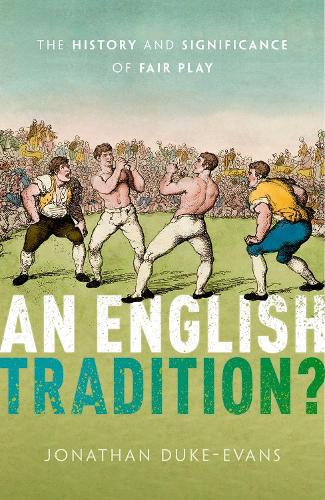
For hundreds of years English people have claimed that fair play is at the core of their national identity. Jonathan Duke-Evans looks at the history of fair play in Britain from earliest times to the present, asking whether it is in fact a British, or alternatively an English, characteristic at all - and if so, whether fair play still matters today?
In An English Tradition?, Jonathan Duke-Evans explores the origins of the idea of fair play, tracing it back to the classical world and the Dark Ages, and finding its genesis deep within England's social structure. Charting its early development through both the tales of chivalry and the stories of popular legend, the book shows how fair play manifested itself in literature, the law, the Christian religion, and the family. It examines the way in which fair play was conceived during the ages of slavery and empire, and it proposes a new account of the birth of modern sport in the encounter between age-old popular games and the Victorian cult of amateurism. Taking in the Scottish, Irish, and Welsh manifestations of fair play, Duke-Evans offers contrasts and comparisons from cultures all around the world, and suggests new perspectives on the relevance of fair play in the twenty-first century.
"what Duke-Evans shows with an impressive mass of evidence is that ... 'fair play' really has had a unique influence on how Britons think of themselves" - Sam Leith, Sunday Times
"a pleasant surprise ... ambitious and wide-ranging" - Robert Tombs, The Daily Telegraph
"Rigorous and personable, fluently navigating potentially dry or finicky subject matter" - Henry Hitchings, The Times
"An original, scholarly and extremely readable history of what is often regarded, by the English anyway, as an essential attribute of their national character" - Sir Keith Thomas, author ofReligion and the Decline of Magic
"The book is leavened throughout with the lightness of touch and wry humour of an escaped academic and career civil servant; it succeeds in every respect." - Patrick Nash, Catholic Herald