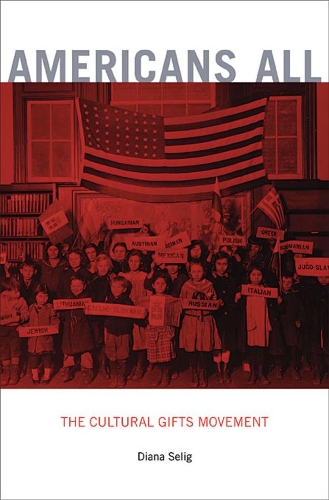
Книга Americans All: The Cultural Gifts Movement
Selig offers an insightful and well-written study on the wide range of efforts to promote interethnic and multicultural understandings during the interwar period. She historicizes the bomb-scarred terrain of the late twentieth-century culture wars, challenging the idea that multiculturalism grew out of the merger in the 1960s and 1970s of group and individual rights activism and ethnic revivalism. The work also fits in nicely with the most important trends in civil rights literature, as Selig argues that multicultural education has a much longer and more complex history than we have believed. Americans All is a unique and exciting contribution. -- Jonathan Holloway, Yale University An excellent and original work-carefully researched, cleverly organized, and, best of all, beautifully written. Diana Selig provides our first sophisticated portrait of a tremendously influential movement in American political culture. She neatly bridges intellectual and social history, showing how new ideas percolated from universities into the broader public realm. -- Jonathan Zimmerman, New York University
From the 1920s—a decade marked by racism and nativism—through World War II, hundreds of thousands of Americans took part in a vibrant campaign to overcome racial, ethnic, and religious prejudices. They celebrated the “cultural gifts” that immigrant and minority groups brought to society, learning that ethnic identity could be compatible with American ideals.
Diana Selig tells the neglected story of the cultural gifts movement, which flourished between the world wars. Progressive activists encouraged pluralism in homes, schools, and churches across the country. Countering racist trends and the melting-pot theory of Americanization, they championed the idea of diversity. They incorporated new thinking about child development, race, and culture into grassroots programs—yet they were unable to address the entrenched forms of discrimination and disfranchisement faced by African Americans in particular. This failure to grasp the deep social and economic roots of prejudice ultimately limited the movement’s power.
In depicting a vision for an inclusive American identity from a diverse citizenry, Americans All is a timely reminder of the debates over difference and unity that remain at the heart of American society.
"This fascinating and intensively researched monograph moves chronologically and thematically to construct the first major historical study of this movement, which aimed to enhance the American creed by confronting and overcoming the worst prejudicial complications of American diversity. Historians have paid scant attention to the cultural gifts movement because it has been overshadowed by the competing forces and images of the era: rampant racism, nativism, the Red Scare, a domestic "return to normalcy," the apparent demise of progressive reform, the image of the "roaring 1920s" followed by the cataclysm of the depression, and the rise of New Deal politics. Selig, however, persuasively demonstrates how widespread this progressive effort was in enlisting hundreds of thousands of American parents, children, journalists, clergy members, scholars, and educators. The movement was closely linked to "world thinking" and international education, with roots in the growing internationalism of the Progressive Era. As Selig succinctly explains, the movement was one defined by what it opposed—prejudice—and loosely united by what it supported: a "gifts" model of cultural appreciation. The resulting "crusade" sought to teach children and parents that immigrant and minority groups brought significant positive cultural attributes to American society...Americans All adds the essential intellectual and social history of the anti-prejudice crusade of the interwar years to the recent scholarship that has traced pluralism, citizenship, and the often-contradictory forces (liberal as well as conservative) pushing different models of assimilation in the U.S. during the twentieth century." - Reviews in American History
"This timely book takes us back to the interwar origins of contemporary debates in the United States over ethnic studies and multicultural education. It is a welcome antidote given the current rise of anti-immigration sentiment and renewed fears of 'strangers in the land.' …Most of us think of multiculturalism as a late twentieth-century phenomenon, an outgrowth of 1960s liberalism and the ethnic pride movement of the 1970s. Some scholars have traced it back to the World War II and Cold War years. But Selig pushes the origins of contemporary multiculturalism back to the social and cultural ferment following World War I… Aimed at widening the reigning ideas concerning a single, homogeneous American culture, the movement set out to highlight the various contributions—the cultural gifts—that minority groups had given to the canon of American culture. This effort at reeducating white Americans targeted groups central to the reproduction of American culture, such as parents (in their role of educators of the next generation), school teachers, and church leaders." - Journal of American History
"In this remarkable study, Diana Selig traces the emergence of a vibrant movement to promote tolerance of American minorities during the height of the xenophobic 1920s...Americans All makes an important contribution to the historical scholarship on the interwar period by highlighting a widespread effort by white, middle-class Americans to counteract racial prejudice through campaigns of tolerance education. Tracing this process from its roots in 1920s social science through World War II, Selig convincingly shows that teaching cultural gifts had a substantial base of academic and financial support for nearly twenty years. Selig is at her best explaining the emergence of this program, especially how young activists like Littledale, DuBois, and Clinchy constructed their work as a kind of practical application of complex social science findings...Selig's pioneering study helps us understand the origin of antiprejudice and multicultural education in American public schools and the later expansion of black history and ethnic studies. Selig lays a strong groundwork for future scholarship into the cultural gifts movement and the teaching of racial tolerance during a critical era of race relations and early civil rights activism in the United States." - History of Education Quarterly
"Diana Selig expertly describes the multifeceted and complex history of the "cultural gifts" movement in the United States. Americans All: The Cultural Gifts Movement focuses on the unique contributions that each culture brings to American society, particularly in the face of social and political forces such as racism and the ideal of assimilation. Selig artfully articulates the effects such a movement has had on historical and present-day manifestations of tolerance and prejudice, and, conversely, progressiveness and acceptance of the gifts each culture offers. Americans All describes the history of the flourishing contributions of immigrant population groups across the United States between World Wars I and II, and it examines the implications of such cultural transmissions across generations of Americans. Through the examination of the history of prejudice and racism in the United States, Selig offers a basis for the modern-day multicultural movement, and provides a clear account of the social and political influences that have contributed to the movement." - Journal of Negro Education
"Although the 1920s are often associated with ethnic and racial intolerance, Diana Selig's elegantly crafted study identifies a counter-current in a "cultural gifts movement" that celebrated America's ethnic diversity while battling against the prevailing nativism of the decade...Whatever the shortcomings of the cultural gifts movement, one leaves this fine study with renewed appreciation of the work of these multicultural pioneers. If Americans today are not fighting ethnic, religious, and even racial battles in their streets, it is, in some small measure, thanks to their efforts." - Teachers College Record