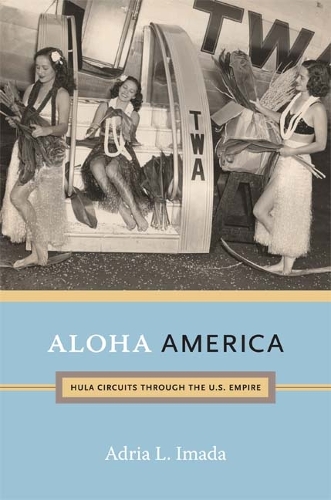
Книга Aloha America: Hula Circuits through the U.S. Empire
Reveals the role of hula in legitimating U.S. imperial ambitions in Hawai'i
Aloha America reveals the role of hula in legitimating U.S. imperial ambitions in Hawai'i. Hula performers began touring throughout the continental United States and Europe in the late nineteenth century. These "hula circuits" introduced hula, and Hawaiians, to U.S. audiences, establishing an "imagined intimacy," a powerful fantasy that enabled Americans to possess their colony physically and symbolically. Meanwhile, in the early years of American imperialism in the Pacific, touring hula performers incorporated veiled critiques of U.S. expansionism into their productions.
At vaudeville theaters, international expositions, commercial nightclubs, and military bases, Hawaiian women acted as ambassadors of aloha, enabling Americans to imagine Hawai'i as feminine and benign, and the relation between colonizer and colonized as mutually desired. By the 1930s, Hawaiian culture, particularly its music and hula, had enormous promotional value. In the 1940s, thousands of U.S. soldiers and military personnel in Hawai'i were entertained by hula performances, many of which were filmed by military photographers. Yet, as Adria L. Imada shows, Hawaiians also used hula as a means of cultural survival and countercolonial political praxis. In Aloha America, Imada focuses on the years between the 1890s and the 1960s, examining little-known performances and films before turning to the present-day reappropriation of hula by the Hawaiian self-determination movement.
"“[An] extensively researched history. . . . Archival digs brought Imada into contact with surviving dancers and their families, whose stories she wove with her own experiences to produce a comprehensive account of how the “adaptive and resilient practice” of hula works in conjunction with tourism. . . .Fascinating photographs of the dancers—with careful commentary on poses and dress—illuminate the mannerisms and views of the performers. “" - Publishers Weekly
"“For a reader who is not deeply familiar with hula and its culture, and may be guilty of watching hula simply for the entertainment factor, Aloha America is a refreshing page-turner. Albeit the moderate level of scholarly information, Imada makes the text easy to digest, also injecting touching anecdotes of hula life behind the stage lights. The final product is a book that is more an interesting field study than strict academic rhetoric.”" - Honolulu Weekly
"“Well written and beautifully illustrated with archival photographs, the book provides dynamic portrayals of individual Hawaiians…With chapter 3, on world exhibitions in the United States, as the book’s centerpiece, Imada tells a lively and layered history of hula circuits in the U.S. empire, an important story about hula practices and people operating beyond Hawaii but never outside its politics.”" - Journal of American History
"“Aloha America is an impressive and provocative book. It will command a broad readership among scholars of American studies, colonial and postcolonial studies, gender studies, indigenous studies, performance studies, and U.S. history.”" - American Historical Review
"“In Aloha America, Adria L. Imada offers a nuanced and detailed study of how hula performers from Hawai’i negotiated the objectifying gaze of audiences...Imada writes in a clear and engaging style, breaking down the theoretical concepts she draws from in concise and digestible fashion.”" - Hawaiian Journal of History
"“Aloha America is an original, important contribution to Asian American studies as it foregrounds Hawaiian cultural movements, U.S. imperialism in the Pacific, and the embodied and emotional intimacies that shape gendered and sexualized relations between colonized and colonizer. It is theoretically sophisticated, empirically robust, and highly engaging...”" - Journal of Asian American Studies
"“Aloha America is a richly textured and engaging narrative of the fraught relationship between the United States and Hawai’i as seen through the lens of hula, the region’s most recognizable and widely circulated cultural practice…. This is an utterly engaging and thorough work of scholarship, and it is a welcome contribution to the fields of dance, theatre, and performance studies, one that also deeply engages indigenous studies, gender studies, and American studies frameworks…. What Imada provides is a deep understanding of racially mixed, commoner-status, (mostly) female artists’ lives as they navigated the globe, imperial politics, and their own modern desires.”" - Theatre Journal