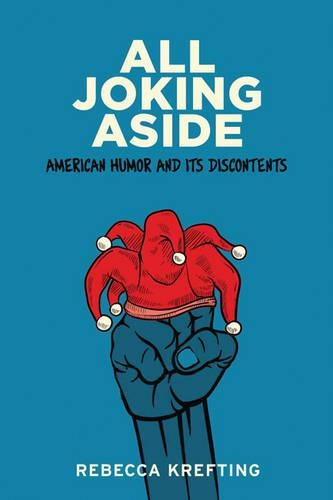
Книга All Joking Aside: American Humor and Its Discontents
A stand-up-comic-turned-scholar, Rebecca Krefting wittily argues for a comprehensive, intersectional rethinking of political comedy. All Joking Aside distinguishes among types of political humor and offers an original theory of "charged comedy" and cultural citizenship. Lively and provocative, this book is a game-changer, and it's fun to read. -- Linda Mizejewski, Author of Pretty/Funny: Women Comedians and Body Politics Feminist comedy? Oxymoronic. Women comics? Not funny. Stand-up comics with a social justice agenda? Don't get me started. Rebecca Krefting atomizes why these stereotypes persist, illuminating the rich world of comedy committed to progressive politics. Her superb, up-to-the-minute, first-of-its-kind study argues that we build cultural citizenship through humor-nothing could be more serious. -- Jill Dolan, Annan Professor of English and Theatre, Director, Program in Gender and Sexuality Studies, Princeton University This is the kind of introspective stuff that only comedians notice. Rebecca does a terrific job of dissecting a very complex landscape. Read this book and enjoy the view under the microscope before someone charges you a two-drink minimum for the privilege. -- Keith Alberstadt, comedian (keithcomedy.com)
In this examination of stand-up comedy, Rebecca Krefting establishes a new genre of comedic production, "charged humor," and charts its pathways from production to consumption. Some jokes are tears in the fabric of our beliefs-they challenge myths about how fair and democratic our society is and the behaviors and practices we enact to maintain those fictions. Jokes loaded with vitriol and delivered with verve, charged humor compels audiences to action, artfully summoning political critique. Since the institutionalization of stand-up comedy as a distinct cultural form, stand-up comics have leveraged charged humor to reveal social, political, and economic stratifications. All Joking Aside offers a history of charged comedy from the mid-twentieth century to the early aughts, highlighting dozens of talented comics from Dick Gregory and Robin Tyler to Micia Mosely and Hari Kondabolu. The popularity of charged humor has waxed and waned over the past sixty years. Indeed, the history of charged humor is a tale of intrigue and subversion featuring dive bars, public remonstrations, fickle audiences, movie stars turned politicians, commercial airlines, emergent technologies, neoliberal mind-sets, and a cavalcade of comic misfits with an ax to grind. Along the way, Krefting explores the fault lines in the modern economy of humor, why men are perceived to be funnier than women, the perplexing popularity of modern-day minstrelsy, and the way identities are packaged and sold in the marketplace. Appealing to anyone interested in the politics of humor and generating implications for the study of any form of popular entertainment, this history reflects on why we make the choices we do and the collective power of our consumptive practices. Readers will be delighted by the broad array of comic talent spotlighted in this book, and for those interested in comedy with substance, it will offer an alternative punchline.