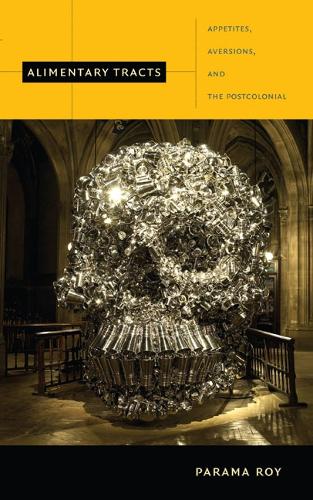
Книга Alimentary Tracts: Appetites, Aversions, and the Postcolonial
Examines the cultural politics of appetite and food in postcolonial South Asia
In Alimentary Tracts Parama Roy argues that who eats and with whom, who starves, and what is rejected as food are questions fundamental to empire, decolonization, and globalization. In crucial ways, she suggests, colonialism reconfigured the sensorium of colonizer and colonized, generating novel experiences of desire, taste, and appetite as well as new technologies of the embodied self. For colonizers, Indian nationalists, diasporic persons, and others in the colonial and postcolonial world orders, the alimentary tract functioned as an important corporeal, psychoaffective, and ethicopolitical contact zone, in which questions of identification, desire, difference, and responsibility were staged.
Interpreting texts that have addressed cooking, dining, taste, hungers, excesses, and aversions in South Asia and its diaspora since the mid-nineteenth century, Roy relates historical events and literary figures to tropes of disgust, abstention, dearth, and appetite. She analyzes the fears of pollution and deprivation conveyed in British accounts of the so-called Mutiny of 1857, complicates understandings of Mohandas K. Gandhi’s vegetarianism, examines the “famine fictions” of the novelist-actor Mahasweta Devi, and reflects on the diasporic cookbooks and screen performances of Madhur Jaffrey. This account of richly visceral global modernity furnishes readers with a new idiom for understanding historical action and cultural transformation.
"“[A]n unusual but much-needed approach to such extraordinary phenomena as the 'greased cartridges' (i.e., ones lubricated with beef and pork fat) and legendary 'migratory chapati[s]' that figure largely in histories of the Sepoy Rebellion (1857) (p. 31). This finely written book draws our attention to other food-related episodes in the history of Indian nationalist resistance, such as Mahatma Gandhi’s discovery of a vegetarian restaurant in London.”" - Studies in English Literature 1500-1900
"“If ever a work took seriously Jacques Derrida’s insistence that we must understand eating as an act through which we both consume and are consumed, it is Parama Roy’s remarkable new book, Alimentary Tracts.”" - Reviews in Cultural Theory
"“Roy’s beautifully produced book looks at writing since the mid-nineteenth century to argue that food, its production, consumption and rejection, are key to an understanding, and rethinking, of wider processes of colonization, decolonization and globalization…. [Her] account is commendable for the extent to which it manages to combine theoretical sophistication with precise historical detail…. It is Roy’s incisive precision, and her embodied understanding of eating that ultimately ensures the broader abstractions of her thesis are by turns convincing and compelling.”" - Year's Work in Critical and Cultural Theory
"“The book that results…is a historically dense, fluidly metacritical, lucidly theorized and exquisitely written meditation on eating as a poetic and political practice in South Asia and its diaspora from the mid-1800s to the present – one that would be of equal interest to postcolonial and literary scholars, as well as to interlocutors of the emerging areas of critical animal studies, posthumanities and food studies.”" - Parallax
"Alimentary Tracts is a rich, theoretically engaging, and wide-ranging survey of the gustatory's significance to Anglo-Indian relations, as well as to the reception of Indian cuisines inside and outside the subcontinent and among non-Indians and Indians in the diaspora. Building on the work of Arjun Appadurai and others, [Roy] convincingly argues that a notion of what constitutes Indian food has provided the English-speaking elite in India and people of Indian origin outside of it with some building blocks of nationality." - Victorian Studies
"Parama Roy’s extraordinary study of the culinary in modern Indian history and literature is among the finest in the burgeoning fields of food studies to systematically question how modes of consumption, patterns of commensality and culinary matters are central to understanding the emergence of the modern nation-state.... A wonderfully detailed study that considered a range of Indian colonial and postcolonial texts spanning short stories, cookbooks, memoirs and novels, this work will be useful to historians interested in examining the multiple meanings that can arise from the use of culinary rhetoric in historical contexts." - Journal of Colonialism & Colonial History