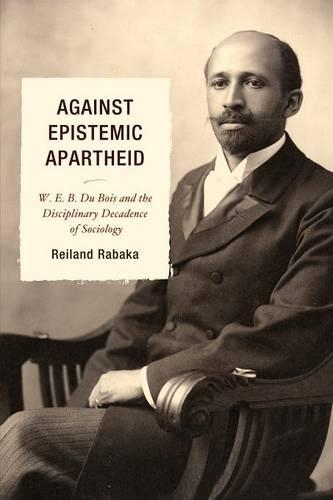
Книга Against Epistemic Apartheid: W.E.B. Du Bois and the Disciplinary Decadence of Sociology
In this intellectual history-making volume, multiple award-winning W. E. B. Du Bois scholar Reiland Rabaka offers the first book-length treatment of Du Bois's seminal sociological discourse: from Du Bois as inventor of the sociology of race to Du Bois as the first sociologist of American religion; from Du Bois as a pioneer of urban and rural sociology to Du Bois as innovator of the sociology of gender and inaugurator of intersectional sociology; and, finally, from Du Bois as groundbreaking sociologist of education and critical criminologist to Du Bois as dialectical critic of the disciplinary decadence of sociology and the American academy. Against Epistemic Apartheid brings new and intensive archival research into critical dialogue with the watershed work of classical and contemporary, male and female, black and white, national and international sociologists and critical social theorists' Du Bois studies. Against Epistemic Apartheid offers an accessible introduction to Du Bois's major contributions to sociology and, therefore, will be of interest to scholars and students not only in sociology, but also African American studies, American studies, cultural studies, critical race studies, gender studies, and postcolonial studies, as well as scholars and students in 'traditional' disciplines such as history, philosophy, political science, economics, education, and religion.
"Reiland Rabaka offers a much-needed critique of sociological technique and practice, and he proposes a corrective to the long-standing malicious negation of Du Bois’s prophetic and progressive sociological perspective.... As we come to the end of this book, we are left satisfied, convinced, and enlightened by the author’s characterization of Du Bois as a 'transdisciplinary human scientist and critical social theorist.' ... Finally, this volume is necessary reading for the newly reinvigorated interest in Du Bois’s contribution to sociology, history, philosophy, political science, economics, education, criminology, and religion." - American Journal of Sociology
"This book is well written and draws heavily from primary sources. Recognizing that Du Bois’ interdisciplinary approach to the study of society was first introduced at a time when sociology’s academic boundaries were being established and canonized, Rabaka argues that Du Bois’ social studies are transdisciplinary.... Providing a comprehensive overview of Du Bois’ extensive social discourse, Rabaka’s Against Epistemic Apartheid makes a significant contribution to the history of sociology, critical race theory, and Africana studies." - Contemporary Sociology