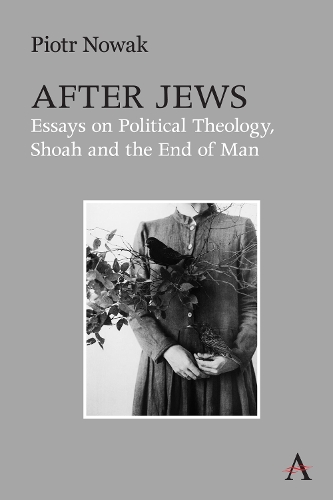
Книга After Jews: Essays on Political Theology, Shoah and the End of Man
Critically interprets the condition of man living in the shadow of the Shoah, in the world “after Jews”.
The basic idea of this book is an attempt to describe and critically interpret the condition of man living in the shadow of the Shoah, in the world “after Jews”. The author achieves this by referring to the language of political theology, renewing the meaning of such theological concepts as eternity, salvation, the idea of the chosen people, apocalypse, radical hope, and others. He seeks an answer to the question of the conditions for the possibility of the Shoah, all this in order to better understand today’s growing aggression against people of strong faith, strong traditional beliefs. Is the disturbing thought of the recurrence of the Shoah, the repetition of the worst scenario that has already happened once in the modern world, an overstated thought, an exaggerated suspicion, a neurosis? The author asks several twentieth-century writers and philosophers such as René Girard, D.H. Lawrence, Jacob Taubes, Joseph Roth, Primo Levi, Jean Améry, W.G. Sebald, K.K. Baczyński, Czesław Miłosz, Krzysztof Michalski, Jonathan Lear, Hannah Arendt, Vasily Rozanov, Giorgio Agamben, and Martin Heidegger to answer these disturbing questions. The exceptions are William Shakespeare and St. Paul, who, however, can also be considered contemporary because of their timeless presence.
Jews had lived with us for a thousand years. Then they were killed. Why? Had the Shoah always been brewing in these lands, or could it only happen under the conditions of late capitalism rather than in the atmosphere of primitive pogroms, the violent expulsion of Jews from their Anatevkas? An important point of reference for the author’s reflections are the postulates of the representatives of the Frankfurt School – in particular of Max Horkheimer and Theodor W. Adorno’s Dialectic of Enlightenment – who were the first to draw attention to the potentially criminal character of instrumental reason, disavowing at the same time the tradition of the siècle des Lumières, the approach which the author is inclined towards. Yet they looked for the causes of the Shoah not where these could be found, either in the “authoritarian personality” or in the difficulties of living, in the so-called “social question.” However, in order to understand what happened to the Jews in Central and Eastern Europe in the 1940s, one must resort to a language completely different from psychological, social, economic, or police discourse. We must resort to the forgotten language – or better said, the language that is being forgotten – of theology, especially political theology. It is there, the author claims, that one can find the right interpretative tools. It does not belong to the realm of superstition but is our last chance to understand what happened to the world yesterday and what is happening to it today. “It was the devil!” writes Alain Besançon, a witness of those times, “He was the one who communicated his inhuman personality to his subjects.” We do not know this for sure – maybe yes, maybe no. We do know, however, that it is good that a theological category – the concept of the devil, Antichrist – is returning to the philosophical and, more broadly, social and political discourse. The devil, Antichrist is not just a metaphor or a creature with a limp in the left leg and charred wings; it is rather the atmosphere we live in, manifesting itself in turning traditional values inside out, in replacing respect with tolerance, charity with dubious philanthropy, love with sex, family with any social organization, religion with science, freedom with safety and so on. Examples abound.
The author proposes to renew the sense of such theological concepts as eternity, salvation, the idea of chosenness, apocalypse, radical hope, and others, only to better understand the condition of today’s world and its increasingly aggressive attitude towards people of strong faith, which may fill us with anxiety and make us think of the recurrence of the Shoah.
There are no more Jews in Poland. They had been murdered by the German Nazis, and those who survived were expelled by the Polish communists after the war. We live in a world “after Jews.” Now we must tell ourselves what it means to us. It is important for them and for us. Important for the world.