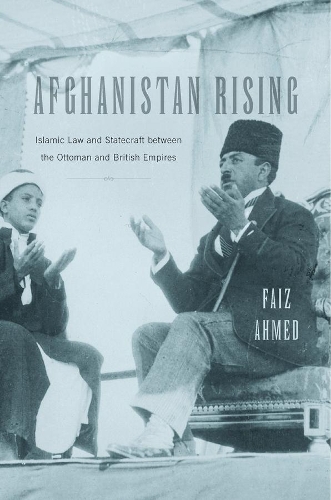
Книга Afghanistan Rising: Islamic Law and Statecraft between the Ottoman and British Empires
Debunking conventional narratives of Afghanistan as a perennial war zone or marginal frontier, Faiz Ahmed presents a vibrant account of the first Muslim-majority country to gain independence from the British Empire, form a fully sovereign government, and promulgate an original constitution after the fall of the Ottoman Empire.
Far from a landlocked wilderness, turn-of-the-twentieth-century Afghanistan was a magnet for itinerant scholars and emissaries shuttling between Ottoman and British imperial domains. Tracing Afghans’ longstanding but seldom examined scholastic ties to Istanbul, Damascus, and Baghdad, as well as greater Delhi and Lahore, Ahmed vividly describes how the Kabul court recruited jurists to craft a modern state within the interpretive traditions of Islamic law and ethics, or shariʿa, and international legal norms. Beginning with the first Ottoman mission to Kabul in 1877, and culminating with parallel independence struggles in Afghanistan, India, and Turkey after World War I, this rich narrative explores encounters between diverse streams of Muslim thought and politics—from Young Turk lawyers to Pashtun clerics; Ottoman Arab officers to British Raj bureaucrats; and the last caliphs to a remarkable dynasty of Afghan kings and queens.
By unearthing a lost history behind Afghanistan’s independence and first constitution, Ahmed shows how debates today on Islam, governance, and the rule of law have deep roots in a beleaguered land. Based on research in six countries and as many languages, Afghanistan Rising rediscovers a time when Kabul stood proudly for anticolonial coalitions, self-determination, and contested visions of reform in the Global South and Islamicate world.
"This remarkable piece of research is based on archival materials in six different languages in six different countries…Among the themes that run through the work are: the role of an interlinked juridical network in fashioning Afghanistan’s first constitution; the fact that the ulema and scholars of the time were flexible and imaginative enough to develop the constitution using Hanafi jurisprudential techniques; and that in the process they produced a form of Islamic modernism to match, if not surpass, those produced in Egypt and India. This is essential reading for those interested in the late Ottoman world, the modern history of Afghanistan, and Islamic modernism." - Journal of Islamic Studies
"Ahmed presents a very compelling, accessible, and beautifully written argument in his book. Drawing on Turkish, Afghan, and British archival sources, as well as material in Persian, Ottoman Turkish, Arabic, and Urdu, he is highly successful in recovering modern Afghan history from its relegation to the periphery of the Muslim world." - Die Welt des Islams
"Ahmed produces a riveting, unexpected history…that is not aligned with standard narratives that we are more familiar with. By capturing the richness and urgency of the development of Islamic law in Afghanistan, Ahmed provides us with a poignant story of a dynamic Muslim-majority country not yet overwhelmed by colonial interests, on the eve of it being overrun by a surfeit of neocolonial jurisdictions." - Comparative Studies of South Asia, Africa and the Middle East
"If Afghanistan’s place in this wider legal canvas of Islamicate Eurasia was once poorly represented, we have Ahmed to thank for filling in the contours, and with such empirical and theoretical panache. No longer can Afghanistan be seen as merely the passive receptacle of Islamic legal ideas elaborated elsewhere and transplanted to the country, nor does it fit the mold of Kemalist Turkey and Pahlavi Iran. Now we are forced to think of the country as productive of new Islamic legal realities, which, though drawing inspiration from models originating in British India and the Ottoman Empire, achieved something unique." - Comparative Studies of South Asia, Africa and the Middle East
"Ahmed has given us a rich, detailed, and engaging account of how developments in and between the Ottoman Empire and British India are necessary—though not sufficient—to understand developments in Afghanistan’s legal history. Afghanistan Rising is a book that should be engaged not only by scholars of Afghan or Ottoman history, but by anyone interested in the intricacies of Islamic law and the modern state." - H-Net Reviews
"Very few historians of modern Islam move beyond, as Ahmed does, the artificially constructed regions of area studies. In synthesizing sources not normally put together—Ottoman Turkish documents on Afghanistan alongside British ones, and Afghan treatises on Islamic law that receive little attention at all—Afghanistan Rising illustrates the fruitfulness of transregional historiography." - Law and History Review
"The author’s exhaustive research uses British, Indian, Afghan, and Turkish sources. This important book is very well resourced and well written. Its research and conclusions should lead to the rethinking of the historical role of Afghanistan." - Choice
"We are still building the foundations for a critical, transnational, connected, global, and regional history of Afghanistan in the world, and Ahmed’s work is a significant contribution to that emerging scholarly project. Afghanistan Rising is bound to be of interest to scholars from a wide range of area studies and fields." - Iranian Studies
"Uses the drafting of the 1923 Afghanistan Constitution—the first for a Muslim majority nation [after World War I]—to not only offer an intellectual and legal history of the country, but also to provide valuable insights into the interactions within the Muslim world at the turn of the 19th century, when the West was gearing up for global wars." - Pakistan Today
"This book provides a significant insight…into the role of Muslims from other nations in Afghanistan. It is an antidote to the many books we have that tell us what Westerner workers have done for Afghanistan." - Afghan Eye
"Ahmed argues that at the turn of the 20th Century, Afghanistan attempted to create a modern, constitutional state within the Islamic law tradition. Very few Americans know about this historical episode, or why the attempt to modernize the country ultimately failed. This book looks to be a useful resource for scholars and policymakers." - Law and Religion Forum