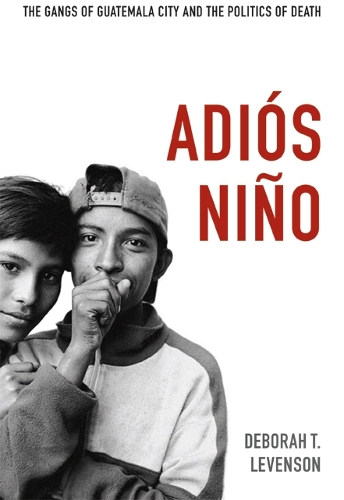
Книга Adiós Niño: The Gangs of Guatemala City and the Politics of Death
In Adios Nino, Deborah T. Levenson examines transformations in the Guatemalan gangs called Maras between their emergence in the 1980s and the early 2000s.
In Adiós Niño: The Gangs of Guatemala City and the Politics of Death, Deborah T. Levenson examines transformations in the Guatemalan gangs called Maras from their emergence in the 1980s to the early 2000s. A historical study, Adiós Niño describes how fragile spaces of friendship and exploration turned into rigid and violent ones in which youth, and especially young men, came to employ death as a natural way of living for the short period that they expected to survive. Levenson relates the stark changes in the Maras to global, national, and urban deterioration; transregional gangs that intersect with the drug trade; and the Guatemalan military's obliteration of radical popular movements and of social imaginaries of solidarity. Part of Guatemala City's reconfigured social, political, and cultural milieu, with their members often trapped in Guatemala's growing prison system, the gangs are used to justify remilitarization in Guatemala's contemporary postwar, post-peace era. Portraying the Maras as microcosms of broader tragedies, and pointing out the difficulties faced by those youth who seek to escape the gangs, Levenson poses important questions about the relationship between trauma, memory, and historical agency.
"[An] extraordinary history of the gangs of Guatemala City.... Above all the ethnographic work of an oral historian, Adiós Niño subtly weaves into its analytical fabric an eclectic array of theoretical voices, from Enrique Dussell to Michel Foucault." - Los Angeles Review of Books
"“[T]his is the book on gangs we need to read.”" - NACLA Report on the Americas
"“Deborah Levenson’s Adiós Niño is to date the most historically nuanced work on Guatemalan gangs…. Levenson’s work earns a place on the essential reading list not only of scholars interested in gangs and Central America, but of all those interested in human rights and the effects of their systematic suppression in impoverished societies.”" - Human Rights Review
"“This book is a must read, not only for those who are interested in Guatemala…. I don’t know that I have seen a better explanation of what happens when revolutions fail, or a better explanation for why Guatemala’s contemporary youth gangs ought to be seen, as Levenson puts it, as 'orphans of the world' (98).”" - Journal of the History of Childhood and Youth
"“The book is beautifully written… superb.”" - American Historical Review
"Adiós Niño is simultaneously painful and important.... This riveting account is a particularly good book to teach, especially at the advanced undergraduate and graduate level: it grapples with many issues, and although it doesn’t necessarily resolve them, it unmasks and demonstrates the rigors and some of the key components of the intellectual quest." - American Anthropologist
"[A] tremendous achievement. Any scholar of Latin America, urban studies, youth, crime, postwar politics, or memory will find rich theoretical and methodological interventions here. Levenson packs much insight into this slim, elegant volume, offering a surgical exegesis of the relationships between history, violence, and trauma.”" - The Historian
"“[T]his is a well-written and accessible work that incorporates a much-needed historical perspective to the study of street gangs in Central America. The volume will appeal to researchers of different disciplines – notably history, anthropology and the political sciences – who specialise in gangs, security, the quality of democracy and Central America.”" - Bulletin of Latin American Research
"Deborah Levenson presents a refreshing depiction of these supposedly transnational gangs, essentially turning this characterization on its head. A trained historian with broad and deep knowledge of Guatemala, Levenson assembles a wide array of data and information she has accumulated over decades of work in Guatemala into a convincing argument. The result is a complex, rich portrayal of gangs in Guatemala...." - Contemporary Sociology