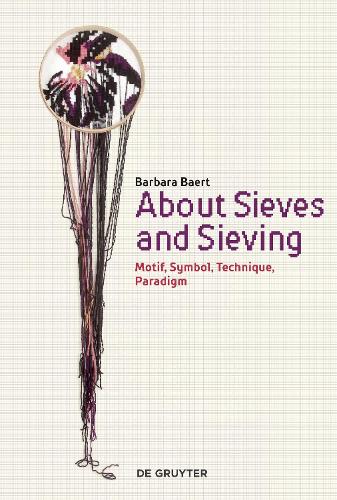
Книга About Sieves and Sieving: Motif, Symbol, Technique, Paradigm
The sieve exhibits a wide-ranging symbolism that extends across art history, philosophy, anthropology, psychoanalysis, and gender studies. Barbara Baert looks at the sieve from an interdisciplinary perspective and from four different innovative methodological angles: as motif and symbol, as technique and as paradigm.
The sieve as motif goes back to Roman stories the Vestal Virgins. In later times, their impermeable sieve, which - according to legend - they used to fetch water from the River Tiber, was iconographically transferred to Elisabeth I as a sign of her integrity. Furthermore, the long durée life of sieves as symbolic-technical utilitarian object is investigated: in examples from the Jewish folklore, the Berber culture, and ancient Egypt.
The sieve exhibits a wide-ranging symbolism that extends across art history, philosophy, anthropology, psychoanalysis, and gender studies. Barbara Baert looks at the sieve from an interdisciplinary perspective and from four different innovative methodological angles: as motif and symbol, as technique and as paradigm.
The sieve as motif goes back to Roman stories the Vestal Virgins. In later times, their impermeable sieve, which - according to legend - they used to fetch water from the River Tiber, was iconographically transferred to Elisabeth I as a sign of her integrity. Furthermore, the long durée life of sieves as symbolic-technical utilitarian object is investigated: in examples from the Jewish folklore, the Berber culture, and ancient Egypt.
The sieve exhibits a wide-ranging symbolism that extends across art history, philosophy, anthropology, psychoanalysis, and gender studies. Barbara Baert looks at the sieve from an interdisciplinary perspective and from four different innovative methodological angles: as motif and symbol, as technique and as paradigm.
The sieve as motif goes back to Roman stories the Vestal Virgins. In later times, their impermeable sieve, which - according to legend - they used to fetch water from the River Tiber, was iconographically transferred to Elisabeth I as a sign of her integrity. Furthermore, the long durée life of sieves as symbolic-technical utilitarian object is investigated: in examples from the Jewish folklore, the Berber culture, and ancient Egypt.