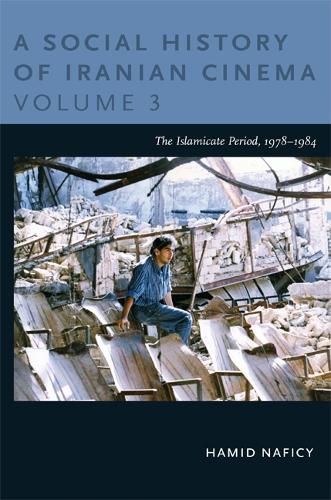
Книга A Social History of Iranian Cinema, Volume 3: The Islamicate Period, 1978–1984
The third volume of Hamid Naficy's four-volume history of Iranian cinema is the shortest, covering the revolution at the end of the Shah's regime and the establishment of the Islamicate state. Movies were seen as a part of the corruption of the Shah's era and a third of the movie houses were destroyed during the revolution. The uprising and revolution were filmed by both amateurs and professionals and Naficy describes what these filmmakers had to do to capture the events. As part of the new Islamic regime's attempt to make a more Islamic film industry, new rules went into effect in 1982 and Naficy shows that the government was not against film per se, only against the portrayal of particular themes or behaviors.
Hamid Naficy is one of the world’s leading authorities on Iranian film, and A Social History of Iranian Cinema is his magnum opus. Covering the late nineteenth century to the early twenty-first and addressing documentaries, popular genres, and art films, it explains Iran’s peculiar cinematic production modes, as well as the role of cinema and media in shaping modernity and a modern national identity in Iran. This comprehensive social history unfolds across four volumes, each of which can be appreciated on its own.
In Volume 3, Naficy assesses the profound effects of the Islamic Revolution on Iran's cinema and film industry. Throughout the book, he uses the term Islamicate, rather than Islamic, to indicate that the values of the postrevolutionary state, culture, and cinema were informed not only by Islam but also by Persian traditions. Naficy examines documentary films made to record events prior to, during, and in the immediate aftermath of the revolution. He describes how certain institutions and individuals, including prerevolutionary cinema and filmmakers, were associated with the Pahlavi regime, the West, and modernity and therefore perceived as corrupt and immoral. Many of the nation's moviehouses were burned down. Prerevolutionary films were subject to strict review and often banned, to be replaced with films commensurate with Islamicate values. Filmmakers and entertainers were thrown out of the industry, exiled, imprisoned, and even executed. Yet, out of this revolutionary turmoil, an extraordinary Islamicate cinema and film culture emerged. Naficy traces its development and explains how Iran's long war with Iraq, the gendered segregation of space, and the imposition of the veil on women encouraged certain ideological and aesthetic trends in film and related media. Finally, he discusses the structural, administrative, and regulatory measures that helped to institutionalize the new evolving cinema.
A Social History of Iranian Cinema
Volume 1: The Artisanal Era, 1897–1941
Volume 2: The Industrializing Years, 1941–1978
Volume 3: The Islamicate Period, 1978–1984
Volume 4: The Globalizing Era, 1984–2010
"“No review could do justice to the wealth of information Naficy has gathered and analyzed...Suffice to say that this volume of social history of the Islamicate period of Iranian cinema from 1978 to 1984 will undoubtedly remain, for many years to come, a must for scholars and students of Iranian cinematic culture and all aficionados, young and old, of Iranian cinema.”" - Middle East Media and Book Reviews
"“This third volume of Hamid Naficy’s epic and authoritative Social History of Iranian Cinema is a goldmine of information for academics and researchers in the field of Iranian cinema. As detailed and as thorough as the previous two volumes, the renowned historian gives us an insight into some of the most turmoil-filled and sombre areas of the history of Iranian cinema.”" - British Journal of Middle Eastern Studies
"“The four volumes of A Social History of Iranian Cinema constitute a landmark achievement. . . . For students of Iranian cinema, I can think of no better place to begin than these four volumes. The sheer expansiveness of Naficy’s project is a testimony to the untold narratives, theoretical paradigms, and concepts waiting to be found in the ongoing history of Iranian cinema.”" - International Journal of Middle East Studies