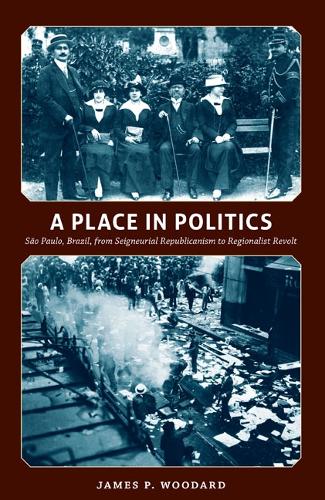
Книга A Place in Politics: São Paulo, Brazil, from Seigneurial Republicanism to Regionalist Revolt
An analysis of the emergence of a distinct political culture in the state of Sao Paulo, Brazil, during the first three decades of the twentieth century
A Place in Politics is a thorough reinterpretation of the politics and political culture of the Brazilian state of São Paulo between the 1890s and the 1930s. The world’s foremost coffee-producing region from the outset of this period and home to more than six million people by 1930, São Paulo was an economic and demographic giant. In an era marked by political conflict and dramatic social and cultural change in Brazil, nowhere were the conflicts as intense or changes more dramatic than in São Paulo. The southeastern state was the site of the country’s most important political developments, from the contested presidential campaign of 1909–10 to the massive military revolt of 1924. Drawing on a wide array of source materials, James P. Woodard analyzes these events and the republican political culture that informed them.
Woodard’s fine-grained political history proceeds chronologically from the final years of the nineteenth century, when São Paulo’s leaders enjoyed political preeminence within the federal system codified by the Constitution of 1891, through the mass mobilization of 1931–32, in which São Paulo’s people marched, rioted, and eventually took up arms against the national government in what was to be Brazil’s last great regionalist revolt. In taking to the streets in the name of their state, constitutionalism, and the “civilization” that they identified with both, the people of São Paulo were at once expressing their allegiance to elements of a regionally distinct political culture and converging on a broader, more participatory public sphere that had arisen amid the political conflicts of the preceding decades.
"“[T]his is what stands out about his project: it does not adhere to traditional issues of the historiography of this period but takes a long view encompassing the transformations of the organization and functions of political life in the state of São Paulo and Brazil. The author carries out this difficult task with considerable ability and skill, bringing together knowledge of traditional issues widely discussed in Brazilian historiography — the República Velha (Old Republic), the politics of the state governors, coronelismo, industrialization, modernism and the 1920s crisis, the ‘ruining’ of the coffee oligarchy, and the 1930 revolution — without losing himself in a tangled web of documents and bibliographical research.”" - Hispanic American Historical Review
"“For the uninitiated, following the detailed intrigues among political rivals—some of whom change sides over the course of their lives—can be challenging. James P. Woodard is to be congratulated for guiding us through this challenging topic. The will be a must read for all those interested in Brazilian politics for years to come.”" - Journal of Social History
"“In A Place in Politics, James P. Woodard masterfully and meticulously unpacks the traditional reading of these four decades and offers a fresh and provocative rethinking of the dynamics of public life and political participation in the early twentieth century.”" - Bulletin of Latin American Research
"“James Woodard provides a rewarding mixture of new and old political historical approaches in this confidently written and richly researched book. . . . A Place in Politics proposes a bold reassessment of early twentieth-century politics that will appeal to Brazilianists and non-Brazilianists alike. In its strong conceptual project—and even more in its thoughtful elaboration of that project—Woodard’s book is a welcome contribution to Latin American political history.”" - The Americas
"“Woodard’s A Place in Politics is an original, culture-oriented reconstruction of São Paulo politics from the decade preceding the fall of the monarchy, in 1889, to the Constitutionalist Revolution of 1932. . . . A Place in Politics is a detailed and well-documented study.”" - Ethnic and Racial Studies