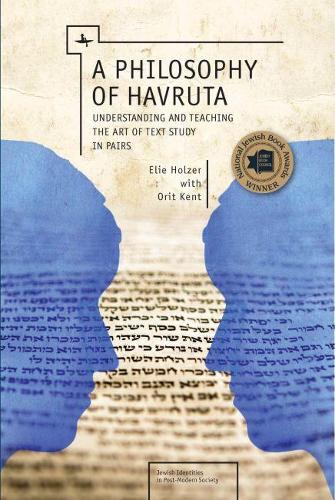
Книга A Philosophy of Havruta: Understanding and Teaching the Art of Text Study in Pairs
The traditional Jewish practice of “learning in havruta” has the potential to enrich both Jewish and general education, and the phrase “havruta-learning” is becoming increasingly popular. Unfortunately, it is also rapidly becoming an empty slogan associated with self-congratulatory but often thoughtless educational activities. This makes Holzer and Kent’s discussion of the nature, value, optimal forms and pre-conditions of havruta-learning very timely. Their first-hand experience with this practice as participants, guides, and researchers and the nuanced philosophical, educational, and Jewish lenses that animate their discussion give rise to a “must-read” book for theorists and practitioners who seek to develop a deep, conceptually rich, practice-relevant understanding of havruta-learning.
A Philosophy of Havruta is an extraordinary accomplishment. Sophisticated and insightful, this book investigates a classic Jewish pedagogy in a way that both unpacks its theory and gives assistance to practitioners. A Philosophy of Havruta is a landmark study—for scholars, for curriculum planners, and for classroom teachers. It will be an essential resource for years to come.
Elie Holzer and Orit Kent champion the idea that havruta text study is not an automatic practice which springs up naturally when two people sit together to study a text. It can and should be taught and learned. Moreover, when the skills and dispositions required for “good” text study in havruta are taught, the learning and the learners are transformed. Few books combine philosophical analysis and pedagogical guidance and present both with such clarity. Teachers at all levels interested in the study of texts and the power of collaborative learning will find conceptual and practical tools to enhance their students’ learning and inspire their teaching. Even more, Elie Holzer and Orit Kent’s model of paired text study, with its emphasis on big ideas and concern for evidence, critical and imaginative thinking and humane interactions, is a microcosm of liberal learning at its best.
No longer confined to traditional institutions devoted to Talmudic studies, havruta work, or the practice of students studying materials in pairs, has become a relatively widespread phenomenon across denominational and educational settings of Jewish learning. However, until now there has been little discussion of what havruta text study entails and how it might be conceptualized and taught. This book breaks new ground from two perspectives: by offering a model of havruta text study situated in broader theories of interpretation and learning, and by treating havruta text study as composed of textual, interpersonal and intra-personal practices which can be taught and learned. We lay out the conceptual foundations of our approach and provide examples of their pedagogical implementation for the teaching of havruta text study. Included are illustrative lesson plans, teachers' notes and students reflections, exercises for students, and other instructional materials for teaching core concepts and practices.