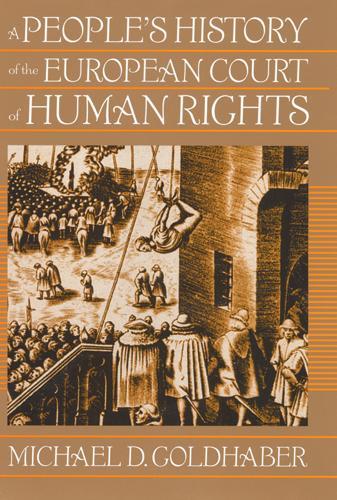
Книга A People's History of the European Court of Human Rights
The exceptionality of America’s Supreme Court has long been conventional wisdom. But the United States Supreme Court is no longer the only one changing the landscape of public rights and values. Over the past thirty years, the European Court of Human Rights has developed an ambitious, American-style body of law. Unheralded by the mass press, this obscure tribunal in Strasbourg, France has become, in many ways, the Supreme Court of Europe.
Michael Goldhaber introduces American audiences to the judicial arm of the Council of Europe—a group distinct from the European Union, and much larger—whose mission is centered on interpreting the European Convention on Human Rights. The Council routinely confronts nations over their most culturally-sensitive, hot-button issues. It has stared down France on the issue of Muslim immigration; Ireland on abortion; Greece on Greek Orthodoxy; Turkey on Kurdish separatism; Austria on Nazism; and Britain on gay rights and corporal punishment. And what is most extraordinary is that nations commonly comply.
In the battle for the world’s conscience, Goldhaber shows how the court in Strasbourg may be pulling ahead.
"A gripping account of the stories behind the cases that have made European human rights jurisprudence the force for moral good that it is today." - director of the Centre for the Study of Human Rights, London School of Economics
"A one-of-a kind account of Strasbourg law." - William F. Starr Professor of Law, University of Connecticut School of Law
"A wonderfully written and researched book that celebrates Europe's achievements in defending human rights through the stories of the victims who took their complaints to the European Court of Human Rights." - Human Rights Centre, University of Essex
"Apart from the legal issues, the stories of lives shattered by torturers are compelling and poignant . . . [G]eneral readers will be rewarded by its lively content and readability. Highly recommended." - Choice
"If you haven't come across this book, all the stories behind the cases are here. It is often funny and always moving, written in a light style that celebrates all those that made the Strasbourg caselaw." - European Human Rights Law Review