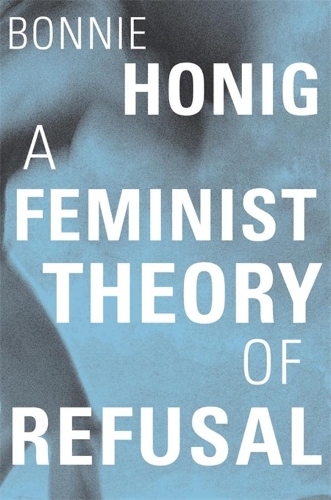
Книга A Feminist Theory of Refusal
An acclaimed political theorist offers a fresh, interdisciplinary analysis of the politics of refusal, highlighting the promise of a feminist politics that does not simply withdraw from the status quo but also transforms it.
The Bacchae, Euripides’s fifth-century tragedy, famously depicts the wine god Dionysus and the women who follow him as indolent, drunken, mad. But Bonnie Honig sees the women differently. They reject work, not out of laziness, but because they have had enough of women’s routine obedience. Later they escape prison, leave the city of Thebes, explore alternative lifestyles, kill the king, and then return to claim the city. Their “arc of refusal,” Honig argues, can inspire a new feminist politics of refusal.
Refusal, the withdrawal from unjust political and economic systems, is a key theme in political philosophy. Its best-known literary avatar is Herman Melville’s Bartleby, whose response to every request is, “I prefer not to.” A feminist politics of refusal, by contrast, cannot simply decline to participate in the machinations of power. Honig argues that a feminist refusal aims at transformation and, ultimately, self-governance. Withdrawal is a first step, not the end game.
Rethinking the concepts of refusal in the work of Giorgio Agamben, Adriana Cavarero, and Saidiya Hartman, Honig places collective efforts toward self-governance at refusal’s core and, in doing so, invigorates discourse on civil and uncivil disobedience. She seeks new protagonists in film, art, and in historical and fictional figures including Sophocles’s Antigone, Ovid’s Procne, Charlie Chaplin’s Tramp, Leonardo da Vinci’s Madonna, and Muhammad Ali. Rather than decline the corruptions of politics, these agents of refusal join the women of Thebes first in saying no and then in risking to undertake transformative action.
"A new and deeply compelling interpretation of Euripides’s Bacchae…Honig’s argument is brilliantly counterintuitive…She rereads the Bacchae to celebrate the women’s freedom and joy." - Political Theory
"Maneuvering through a complex theoretical web, Refusal displays Honig’s characteristic refusal of aridity…Most vital, though, is Honig’s encounter with the Bacchae itself. The tragedy’s devastation ‘illustrates, metaphorically speaking, the breadth and depth of patriarchy’s grasp, its imbrication in everything we love as well as in the structures and powers we resist’…Now that the United States has officially entered its post-Roe reality, Honig’s clarity about feminism’s normative and civic demands rings all the louder. Only in a world without patriarchs could feminist citizenship be claimed without so much bloody sacrifice." - Review of Politics
"Exudes a hopefulness for an anticipated future in which democracy is not always already over but readied, perhaps for the first time, to witness the joy and act on the knowledge of its marginalized subjects…Honig’s writing is elegant, economical, yet alive with a restrained but confident rhetorical flair." - Cultural Critique
"Honig compellingly demonstrates the continued relevancy of ancient Greek tragedy for feminism, at a time when the role of the classics in higher education is increasingly under scrutiny." - Contemporary Political Theory