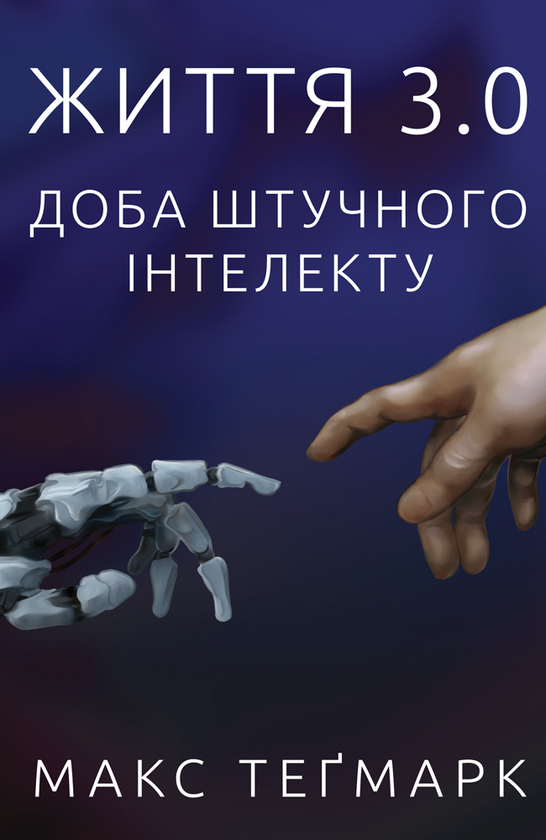
Book Life 3.0: Being Human in the Age of Artificial Intelligence

Real title: Життя 3.0. Доба штучного інтелекту
Product code: 926635

Book Life 3.0: Being Human in the Age of Artificial Intelligence

Real title: Життя 3.0. Доба штучного інтелекту
Product code: 926635
Format
The product is included in the following promotions:
Book language
Publisher
Year of publication
About book

This is an automatically translated description

What will be the economic, military, and social consequences of the emergence of artificial intelligence.

Topic

Sci-fi, futurology, technology, artificial intelligence.

About the book

During its existence, life on Earth has transformed several times - from bacteria, whose development is completely encoded in DNA, to more complex organisms and finally humans, who have a choice and adapt almost instantly to a new environment. This flexibility has allowed humanity to dominate the Earth. But despite significant breakthroughs - language, writing, printing press, modern science, computers - all life forms we know remain hostage to their biological shell. The next stage is the era of artificial intelligence, Life 3.0, which will free itself from the biological shackles of evolution and become the master of its own destiny.

Who is the book for

The book is for anyone interested in the development of technology, robotics, in particular, the introduction of artificial intelligence into all spheres of society and the possible consequences of this process for humanity.

Why this book

In this book, Professor Max Tegmark analyses the economic, legal, military and social consequences of the emergence of artificial intelligence and what this technology will bring to humanity.

About the author

Max Tegmark is a professor at MIT and one of the most respected researchers in artificial intelligence. His Institute for the Future of Life received a $10 million grant from Elon Musk to study the possible consequences of artificial intelligence.

Books on similar topics

Reviews

"It's not just scientists, industrialists, or the military who should be asking themselves: «What can we do to increase the chances of benefiting from artificial intelligence and reduce the risks?', but also all people. This is one of the most important discussions of our time."

Stephen Hawking, renowned astrophysicist

"This is a true guide to the challenges and choices facing people seeking a grand future, consciousness and intelligence on Earth and beyond."

Elon Musk, CEO of Tesla Motors and SpaceX

Quotes

On the fear of the emergence of AI

"The fear of machines becoming conscious is another distraction. The real cause for concern is not malicious intent, but competence. By definition, a super-intelligent AI is very good at achieving its goals, whatever they may be, so we need to align its goals with ours. You may not be an ant hater and you may not trample on insects for no reason, but if you are tasked with building a hydroelectric power plant and an ant hill is found in the area designated for flooding, the ants will have to say goodbye to their lives. The movement for beneficial AI wants to prevent a situation where humanity finds itself in the shoes of these ants."

On the difficulty of tasks for computers

"It is natural for us to rank the difficulty of tasks based on how hard they are for us humans. But this can give a false impression of how difficult they are for computers. We may think it's much harder to multiply 314,159 by 271,828 than to recognise a friend in a photograph, but computers have been leapfrogging us in arithmetic since long before I was born, and human-level image recognition has only recently become possible. The fact that low-level sensorimotor tasks seem easy, even though they require huge computing resources, is known as the Moravec paradox. It is explained by the fact that our brains create the illusion of ease of such tasks because they allocate a huge amount of specialised hardware to them - in fact, more than a quarter of our mental capacity."

Details
Author
Publisher
Number of pages
432
Reviews
0
0
Юрій Пацук
15 July 2020 y.
Про штучний інтелект і не тільки
Надзвичайно цікава книга не тільки про різноманітні питання, пов’язані з проблемою штучного інтелекту, а й про роботу людського мозку, свідомості, виникнення та освоєння Всесвіту, міжгалактичні перельоти, нові види енергії. Але найцікавіше – про вірогідність і часові рамки створення штучного інтелекту, різноманітні сценарії подальшої долі людства в умовах існування штучного інтелекту: від ідилічних, коли штучний інтелект стоїть на службі людям, коли зникають війни, бідність і нужда, до апокаліптичних, коли штучний інтелект завойовує світ і знищує людство або перетворює його на рабів. Штучний інтелект може стати або найкращим, або найгіршим з усього, що траплялося з людством. Хоча, як справедливо зазначає автор, людство може самознищитися набагато раніше моменту створення штучного інтелекту – через колективну дурість. І навіть без штучного інтелекту вже зараз можливі сценарії всезагального хаосу, порівняно з якими нинішня проблема коронавірусу видається дитячою забавкою. Книга захоплює вже від самого свого прологу, де у науково-фантастичній формі змальовується позитивний сценарій появи штучного інтелекту і його завоювання світу. Ну й, звичайно ж, багато наукових фактів, які не можуть не вражати. Наприклад, під час перетравлення шоколадного батончика виділяється всього одна десятитрильйонна доля енергії mc2, яка міститься в батончику. Якби наш шлунок мав ККД хоча б 0,001%, одного обіду нам вистачило б до кінця життя. Порівняно з травленням, спалювання вугілля й бензину ефективніші всього в три та п’ять разів відповідно. Або: при вливанні чайної ложечки антиводи у звичайну воду виділялася б енергія в еквіваленті 200 000 тонн тринітротолуолу – потужність середньої водневої бомби. Цього б вистачило, щоб забезпечити енергією потреби цілого світу десь протягом 7 хвилин. Ще сподобалася ідея «вивантаження» - оцифрування й перенесення людської свідомості з людського тіла на інші носії, наприклад, в оболонку робота (чим не ідея вічного життя або безсмертя душі). Книга однозначно варта уваги!
Светлана
20 August 2019 y.
для общего развития
Сказать, что это целостная работа, концептуально завершенная нельзя. Слишком много футуризма, теорий, предположений и планов по заселению Вселенной гомо сапиенс. Но для стартовых знаний и понимания, что есть искусственный интеллект Жизнь 3.0 будет полезна. К плюсам книги можно отнести: - Детальное пояснение что же это такое, ИИ. Как он функционирует, какие задачи выполняет. Где потолок технологии. Уже немало. - Автор физик и многие вещи пояснены дотошно и со знанием дела. Очень ценно для гуманитариев, например. - Подход контекстный, где понемногу вплетены вопросы безработицы, социального порядка, жизненного уклада, этики в мире, где весомую роль играет искусственный интеллект. - Четкость понятий, определенная вначале. Научно и правильно. Не дает запутаться в новой и сложной теме. - Фактаж, много практических примеров, оценка рисков. Из минусов - Это сборная солянка. Где смешано много слишком разного. - Противоречия. Автор вначале признает, что понимание того, как будет развиваться ИИ все еще слишком туманно. А затем начинает обосновывать, как физик, возможности заселить Галактику и дальше при помощи этого самого ИИ. Который, непонятно по каким принципам будет взаимодействовать\использоваться людьми в будущем. Который непонятно когда сможет стать супер интеллектом и выйти за существующие сегодня ограничения. Детально разжеванные автором вначале. - Поверхностный подход в ряде социально-политических вопросов. Таких, как последствия безусловного дохода. - Поверхностный и ограниченный одной спорной теорией подход к вопросу сознания. Но, учитывая сложность темы, хорошо, что такие книги появляются. Они неидеальны концептуально, но направляют мысли в новое русло.
Do you have any questions? 0-800-335-425
Contact us