This is an automatically translated description
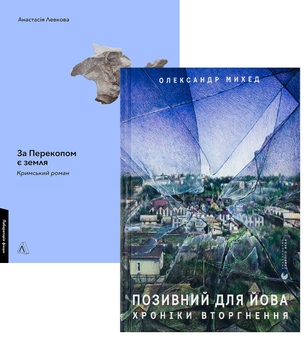
Book 1: There is land beyond Perekop
Long before the annexation of Crimea, she realised that she was Ukrainian. Neither her grandfather, a KGB lieutenant colonel, nor the Russian blood in her veins prevented her from doing so. Her childhood friendship with a Crimean Tatar woman and her acquaintance with this culture became the seed that would later grow into a search for herself and her own national identity."
The novel intertwines Crimean Tatar culture, Ukrainian literature, and family secrets. Together with the protagonist and her friends, the Crimean Tatar Aliye and the Ukrainian Aliona, the reader goes a long way from the girls' childhood to the annexation of Crimea by Russia
: "There is no land beyond Perekop", meaning that it doesn't matter what happens across the isthmus, on the mainland. Anastasia Levkova's novel shows that there is land on both sides of the Perekop. It's
just a matter of getting to know it and stitching it together - opening up the mainland to Crimea, and Crimea to the mainland.
Work on the book has been going on since 2012. With the beginning of the occupation of Crimea in 2014, the concept changed. During this time, the author conducted about 200 interviews with more than 50 Crimeans. The
details of their stories became part of the novel.
Book 2. Call Sign for Job. Chronicles of the Invasion
Oleksandr Mykhed started writing Call Sign for Job on the first day of the large-scale invasion that took place in the eighth year of the Russian-Ukrainian war. The author worked on the book for thirteen months, writing about what he and his wife went through, about his parents, who were in Bucha for almost three weeks during the occupation. It's about how we change, how our everyday language becomes the language of war, how once familiar and important things become painful triggers, and how certain feelings and emotions become things you want to forget, but also remember forever.
This book is not exclusively the author's reflection, but rather the opposite: he has collected and presented the thoughts and experiences of many Ukrainians during the first year of the invasion. Ukrainians, like Job in the Old Testament, are now experiencing terrible losses. How do we lose our closest friends and homes? How are Ukrainian children changing and what kind of post-memory will the next generation have? Finally, who is each of us in this war?