


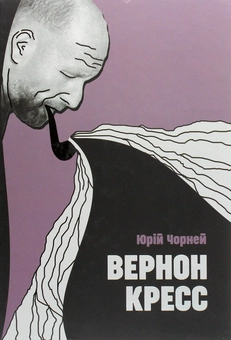
Book Vernon Kress. Life under cover
This is an automatically translated description
Human life is not a generalisation: an ordinary Chernivtsi story about the twentieth century
The geography of life undercover by former Chernivtsi resident Peter Demant includes the Austro-Hungarian Monarchy, the Kingdom of Romania, the First Czechoslovak Republic, the Third Reich, the Union of Soviet Socialist Republics, Russia, many mountain peaks and natural areas, regions and countries on all continents, with the exception of Antarctica. In an amazing way, it intertwines the key events of the most tragic twentieth century in human history.
The protagonist really looks like a kind of wanderer in time and space who accidentally stayed in our era. But it was in this era that, after his worldview-altering first life in interwar, still European Chernivtsi, he was destined to taste prison balanda in Siberian and Kolyma special camps for particularly dangerous (of course, only for the Stalinist authorities) political criminals. And after his release, working as an ordinary loader, he became a pioneer, the godfather of tourism in northeast Eurasia and even the Russian writer Vernon Kress.
But it wasn't just adventures that made this life stand out from the crowd. There was also room for mystery. Numerous acquaintances in the West almost considered the former Chernivtsi resident to be the hero of Josef Martin Bauer's novel "As Long as My Legs Carry Me". The well-known book, which was adapted into a film in 2001, tells the story of the German prisoner of war's wanderings and escape from the Gulag camps. But the writer's Russian friends dubbed Peter Demant the last Tyrolean in Moscow.
This eternal wanderer-optimist had enough reasons to mystify his own past. In captivity, the prisoners not only generously shared their memories, but also exchanged articles, names and even biographies. Sometimes it even seems that perhaps the only fact of his biography that does not require verification or does not imply any other interpretation is the authenticity of the writer's existence. As for his origins, we have to take into account different opinions.
Among people who have lost their historical homeland (in this case, we are talking about Austria-Hungary), the phenomenon is quite common. The void is often filled with fiction. Sometimes it is only a step from mythologising an imaginary world to fantasising about one's own life. However, it also happens that you have to invent for other reasons. Did Peter Demant have such reasons? Obviously! The suspicion of a spy past haunted the writer to the end of the earth.
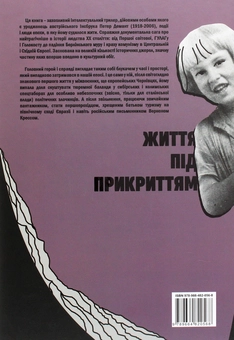
Highly professional historical and biographical non-fiction combines a thorough documentary investigation of the hero's life secrets, which are closely inscribed in the context of the era. This is the case when the biography of one person unexpectedly becomes the biography of a city, a country, an entire generation. (Un)fictional life undercover by Vernon Kress is the story of Chernivtsi and the turbulent twentieth century in the events of one human life.