


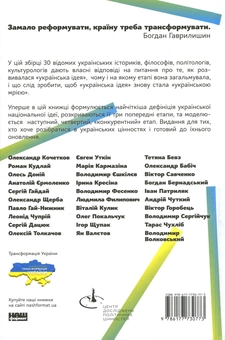
Book Transformation of the Ukrainian national idea
This is an automatically translated description
What should the modern Ukrainian dream look like?
About the book:
This book formulates the definition of the Ukrainian national idea, reveals its three previous stages and models the next, fourth, «competitive» stage. The publication is for those who want to understand Ukrainian values and are ready to update them.
Who the book is for:
The book is for the widest range of readers, anyone interested in history and socio-political processes in Ukraine.
Why you should buy this book:
In this collection, 30 well-known Ukrainian historians, philosophers, political scientists, and cultural critics give their own answers to the questions of how the Ukrainian idea developed, why and at what stage it slowed down, and what should be done to make the Ukrainian idea become the Ukrainian dream again.
Authors:
• Alexander Kochetkov
• Roman Kudlay
• Alexander (Oles) Doniy
• Anatoliy Yermolenko
• Sergey Gaidai
• Alexander Shcherba
• Pavel Gay-Nizhnik
&bullLeonid Chupriy
• Sergey Datsyuk
• Alexey Tolkachev
• Evgeny Utkin
• Maria Karmazina
• Vladimir Yeshkilev
• Irina Kresina
• Vladimir Fesenko
• Lyudmila Filipovich
• Vitaly Kulik
• Oleg Pokalchuk
• Igor Shchupak
• Jan Valetov
• Tetiana Bevz
• Oleksandr Babich
• Viktor Savchenko
• Bohdan Bernadskyi
• Ivan Patryliak
• Volodymyr Volkovskyi
• Andrii Chutkyi
• Viktor Gorobets
• Taras Chukhlib
• Volodymyr Serhiychuk
Books on similar topics:
• «Skoropadskyi. Memoirs of 1917-1918 (Ukrainian translation)» «Our format», 2017
Reviews:
«Ukrainian thinkers have not fully defined the principles on which the newly created state should exist, and on what ideological foundations the new society should be created. That is why Ukraine from time to time demonstrates its ability to fight (the Maidans, the rebuff of Russian aggression), but it is increasingly lagging behind the countries of the European community. Perhaps we should not only change politicians, but also learn to work on goals? Maybe we should learn to adjust ideas?
Oleksandr Doniy, Head of the Centre for Political Values
«Collective memory is a dictator, because it very often makes you remember what you should forget and forget what you should remember. The very power of collective memory lies in the hard choice of only two alternatives: remember or forget. It has no middle ground, although the carriers of collective memory are mostly mediocre. Collective recollection is guided by certain conditions, consciously chosen attitudes, or even unconscious inclinations."Serhiy Datsyuk, philosopher, publicist, blogger