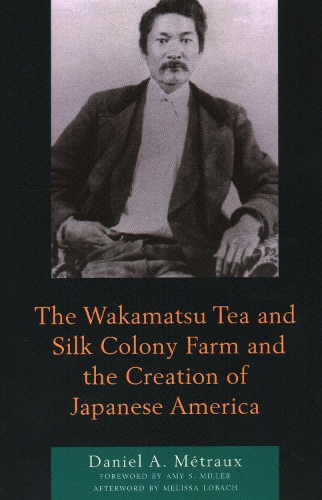
Book The Wakamatsu Tea and Silk Colony Farm and the Creation of Japanese America
Japanese became the largest ethnic Asian group in the United States for most of the twentieth century and played a critical role in the expansion of agriculture in California and elsewhere. The first Japanese settlement occurred in 1869 when refugees fleeing the devastation in their Aizu Domain of the 1868 Boshin Civil War traveled to California in 1869 where they established the Wakamatsu Tea & Silk Colony Farm. Led by German arms dealer and entrepreneur John Henry Schnell, the Colony succeeded in its initial attempts to produce tea and silk, but financial problems, a severe drought, and tainted irrigation water forced the closure of the Colony in June 1871.
While the Aizu colonists were unsuccessful in their endeavor, their departure from Japan as refugees, their goal of settling permanently in the United States, and their establishment of an agricultural colony was soon imitated by tens of thousands of Japanese immigrants.
The Wakamatsu Colony was largely forgotten after its closure, but Japanese American historians rediscovered it in the 1920s and soon recognized it as the birthplace of Japanese America. They focused their attention on a young female colonist, Okei Ito, who died there weeks after the Colony shut down and whose grave rests on the property to this day. These writers transformed Okei-san into a pure and virtuous symbol who sacrificed her life to establish a foothold for future Japanese pioneers in California. Today many Japanese Americans regard the Wakamatsu Farm as their “Plymouth Rock” or Jamestown and have made it a major pilgrimage site.
The American River Conservancy (ARC) purchased the Wakamatsu Farm property in 2010. ARC is restoring the site’s historic farm house and is working to protect the Farm’s extensive natural and cultural history.
"There are books that I feel all members of the Japanese American community should have in their personal library. . . . I’d recommend that people also add “The Wakamatsu Tea and Silk Colony Farm and the Creation of Japanese America” to their libraries. . . The academic book is a carefully researched work that eliminates any romantic notions about the first Japanese agricultural colony in mainland United States, which was established in Gold Hill, California, in 1869. . . . Perhaps the biggest takeaway from reading Métraux’s work is that we can’t make broad generalizations of Japanese immigrant pioneers. As researchers dig deeper, we may discover surprises that challenge how we view ourselves and even our larger ethnic community." - Nichi Bei Weekly