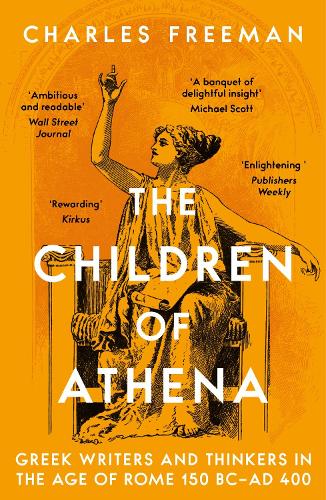
Book The Children of Athena: Greek writers and thinkers in the Age of Rome, 150 BC–AD 400
A portrait of the continuing intellectual tradition of Greek writers and thinkers in the Age of Rome.
A compelling and fascinating portrait of the continuing intellectual tradition of Greek writers and thinkers in the Age of Rome. In 146 BC, Greece yielded to the military might of the Roman Republic; sixty years later, when Athens and other Greek city-states rebelled against Rome, the general Lucius Cornelius Sulla destroyed the city of Socrates and Plato, laying waste to the famous Academy where Aristotle had studied. However, the traditions of Greek cultural life would continue to flourish during the centuries of Roman rule that followed, in the lives and work of a distinguished array of philosophers, doctors, scientists, geographers, travellers and theologians. Charles Freeman's accounts of such luminaries as the physician Galen, the geographer Ptolemy and the philosopher Plotinus are interwoven with contextual 'interludes' that showcase a sequence of unjustly neglected and richly influential lives. Like the author's The Awakening, The Children of Athena is a cultural history on an epic scale: the story of a rich and vibrant tradition of Greek intellectual inquiry across a period of more than five hundred years, from the second century BC to the start of the fifth century AD.
"An enlightening survey of the Greek intellectual tradition during the Roman Empire." - Publishers Weekly
"Well-informed, rewarding analysis of an unjustly overlooked period and its intellectual legacy." - Kirkus
"Ambitious and readable...I know of no other survey of intellectual life in the imperial Greek world accessible to the non-specialist reader." - The Wall Street Journal
"Too often we ask what the Romans did for us – but this important and beautifully written book reminds us to ask what the Greeks did for the Romans – and for us in turn! This is a banquet of delightful insight, important ideas and colourful characters." - Michael Scott
"Charles Freeman's latest effusion of cultural history is a paean of tributes to ancient Hellenic intellection, philosophical in both a technical and a more general sense... Freeman sportingly and illuminatingly engages with a wide variety of styles of thought and expression, from epideictic oratory and satire via historiography and mathematics to philosophy proper. Sophisticated Greek culture did not only take firm hold of the Greeks' Roman conquerors' imaginations: thanks to Byzantium and the Renaissance (other specialisms of our exceptionally broadminded author), it engages us still to this day." - Paul Cartledge
"This is a much-needed book. The astounding brilliance of Greek writers of the Classical period, the fifth and fourth centuries BCE, is well known. But Greek learning did not end with the end of the Classical period. Freeman demonstrates the extraordinary richness and the variety of the work being done by the Greek intellectuals of the Roman empire... We meet orators, philosophers, historians, geographers, astronomers, a travel writer, a medical botanist, physicians, a satirist, polymaths with various interests and Christian scholars. Gradually a picture emerges of the magnificence – and the lasting importance – of work being done by the Greek intellectuals of the Roman empire." - Robin Waterfield, author of Plato of Athens: A Life in Philosophy
"This book brings together a gallery of fascinating personalities, a group of Greek intellectuals — controversialists, scientists, and scholars — to elucidate the role they each played in the discourse and intellectual life of the Roman Empire and beyond. The varied contribution of these famous individuals places them, without doubt, in the centre of Roman intellectual life and explains the long-lasting influence they have had on European literature, science, and scholarship. Freeman brings them to life so they can resonate amongst us and show off the height of their achievements once more. A much needed reminder of the wonders of late antiquity and the birth of European scholarship." - Christos Nifadopoulos, PhD, Cambridge University