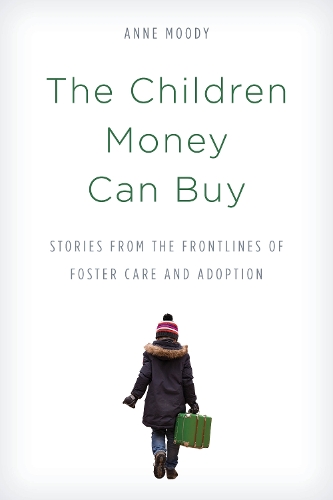
Book The Children Money Can Buy: Stories from the Frontlines of Foster Care and Adoption
The Children Money Can Buy covers decades of dramatic societal change in foster care and adoption, including the pendulum swings regarding open adoption and attitudes toward birth parents, the gradual acceptance of gay and lesbian adoption, the proliferation of unregulated adoption facilitators in the U.S., ethical concerns related to international adoption, and the role money inevitably plays in the foster care and adoption systems. Special attention is given to the practice of “baby brokering” and the accompanying exorbitant finder’s fees and financial incentives encouraging birth mothers to relinquish (or pretend that they are planning to relinquish) their babies that permeate much of U.S. infant adoption today. The Children Money Can Buy illuminates the worlds of foster care and adoption through the personal stories Moody witnessed and experienced in her many years working in the foster care and adoption systems. These compelling stories about real people and situations illustrate larger life lessons about the way our society values—and fails to value—parents and children. They explore the root of ethical problems which are not only financially driven but reflect society’s basic belief that some children are more valuable than others. Finally, Moody makes a plea for change and gives suggestions about how the foster care and adoption systems could work together for the benefit of children and families.
"As a young 20-something with a master’s degree in social work, Moody took a job as a child-welfare caseworker that introduced her to the world of adoptions and foster care, beginning a lifelong commitment that is chronicled in this compassionate work. Moody touches on the adoption sector’s ugly side, such as ‘baby buying’ and profit-driven adoption facilitators. She takes care to counterbalance these negatives, however, by also detailing the positive changes that have occurred in the field over the course of her career. These include the increasing acceptance of ‘open adoptions,’ in which birth parents are allowed to play some role in their children’s lives, and of same-sex couples as adopters. Throughout, Moody shares the personal experiences of many children and parents (whose identities are protected), some happy, some sad. The author also recalls her commitment at 13 to eventually become an adoptive parent, a dream she made real 23 years later. Moody's experiences certainly inform her practical approach, which touches on subjects including how to talk about adoption with children and how adoptive families can present themselves to the outside world. For any family that has faced the difficult issues of adoption or fostering from any perspective, Moody's book will be a valuable tool." - Publishers Weekly