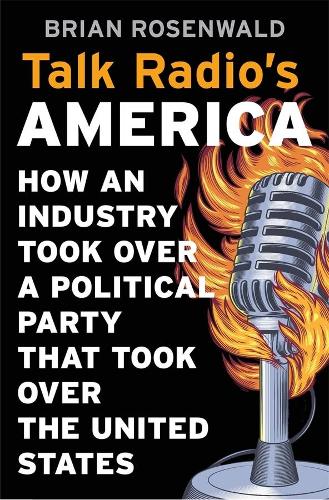
Book Talk Radio’s America: How an Industry Took Over a Political Party That Took Over the United States
The cocreator of the Washington Post’s “Made by History” blog reveals how the rise of conservative talk radio gave us a Republican Party incapable of governing and paved the way for Donald Trump.
America’s long road to the Trump presidency began on August 1, 1988, when, desperate for content to save AM radio, top media executives stumbled on a new format that would turn the political world upside down. They little imagined that in the coming years their brainchild would polarize the country and make it nearly impossible to govern. Rush Limbaugh, an enormously talented former disc jockey—opinionated, brash, and unapologetically conservative—pioneered a pathbreaking infotainment program that captured the hearts of an audience no media executive knew existed. Limbaugh’s listeners yearned for a champion to punch back against those maligning their values. Within a decade, this format would grow from fifty-nine stations to over one thousand, keeping millions of Americans company as they commuted, worked, and shouted back at their radios. The concept pioneered by Limbaugh was quickly copied by cable news and digital media.
Radio hosts form a deep bond with their audience, which gives them enormous political power. Unlike elected representatives, however, they must entertain their audience or watch their ratings fall. Talk radio boosted the Republican agenda in the 1990s, but two decades later, escalation in the battle for the airwaves pushed hosts toward ever more conservative, outrageous, and hyperbolic content.
Donald Trump borrowed conservative radio hosts’ playbook and gave Republican base voters the kind of pugnacious candidate they had been demanding for decades. By 2016, a political force no one intended to create had completely transformed American politics.
"Rejecting claims that the medium acted as a Republican puppet, [Rosenwald] describes a curious relationship between the Grand Old Party and talk radio hosts, one that has had seriously deleterious consequences for American political life." - Financial Times
"[Rosenwald] argues that the profit motive radicalized talk radio and with it the Republican Party…Because conflict and scaremongering drove ratings and ratings drove profits, the more extreme the hosts became, the more listeners they gained, and the more money they made. As they amassed power and influence, the hosts could demand fealty from the politicians they were discussing every day." - The Nation
"A brisk, well-researched history of the rise and transformation of talk radio…A vigorous analysis of contemporary politics." - Kirkus Reviews
"Demonstrate[s] that broadcasters like…Rush Limbaugh were just as important to building the Republican Party as deified political figures like George Wallace, William Buckley, or Pat Buchanan. Indeed, far from being a mere tool of the Republican Party, talk radio is revealed…as the dominant explanation for that party’s continued existence, an essential precondition of the far right’s cultural dominance today." - New Republic
"Important and groundbreaking…Expertly shows how disparate strands in the American political landscape converged in the late 1980s to help make talk radio the potent political force it would become…A must-read for anybody hoping to understand how Trump captured the Republican presidential nomination." - Washington Examiner
"Rosenwald takes a look at the rise of conservative radio from a variety of perspectives and offers a clear study of how policies, market forces, personalities, and timing played a role in creating a movement…The book is interesting from beginning to end." - European Legacy
"An informative account of talk radio and its impact on politics and policymaking." - Pittsburgh Post-Gazette
"In his 2016 presidential run, Donald Trump utilized styles of rhetoric similar to those of talk radio hosts in order to garner a strong base of loyal followers and rile up political activism amongst his supporters…This book could prove useful for those interested how media—both the form factor and the communicative aspects—affect political standing." - Communications Booknotes Quarterly
"Documents Limbaugh’s formative role in turning an old technology into an instrument of power that transformed the Republican Party and political discourse in the United States…An important book…Goes a long way to documenting how an old medium helped create a new politics in the United States and paved the way for Donald Trump’s presidency." - IEEE Technology and Society Magazine