

Book In Praise of Dialectics
This is an automatically translated description
This book contains 60 poems by Bertolt Brecht; the great poet and playwright, revolutionary, reformer, anti-fascist, who was born in Kaiser's Germany, gained scandalous fame on the theatre stages of the Weimar Republic, was expelled from the country by the Hitler regime, changed countries of residence for a decade and a half, and at the end of his extremely difficult and turbulent life became an officially recognised classic and laureate in socialist Germany, for which many people still cannot forgive him.
Brecht began writing poetry early (and immediately brightly), wrote a lot of it (the complete collection contains more than 2300 texts), and wrote to the last. His poetic heritage, as in the case of many great poets, reflects his immediate life path quite accurately: it is just as complex and troubled. Therefore, a few remarks should be made at the outset.
First of all, this collection should not be considered Brecht's «best» poems. After all, what is the best here? What is worse? It's like choosing the best birds in a colourful and noisy flock of birds that flies down from the station's roof. The flock fascinates by itself: its movement, its strength, and, above all, its noise. In the case of Brecht's poetry, it is important to understand not only the text but also the context. As you read this collection, you will notice how heterogeneous (and ambiguous) the works contained in it are. This is quite natural: Brecht wrote classical sonnets, zongs for singing to the guitar, texts for the theatre stage, which had to fulfil their dramatic task, not always obvious beyond the plot twists and psychology of the characters. He also wrote political pamphlets in verse, proclamations, manifestos (he even rewrote the Communist Party Manifesto in hexameter, but it is not here, so don't look for it). In addition, he wrote paradoxical piercing couplets. And, of course, quite academic rhyming ballads. He also easily resorted to stylisations and free borrowings, both genre and purely stylistic. He was also fascinated by the Orient, which was especially reflected in his later poems. He also had the ability to turn everything that came to his attention into poetry, so his poems often resemble fragmentary, interrupted, spontaneous diary entries. And what do they resemble: they often are. In a word, the purpose of this collection of translations was to show - at least in a stroke, in outline, in passing - all this immensity of ideas, plans and methods, all Brechtian vastness of searches and interests, themes and characters, favourite means and most iconic characters. Therefore, this is a collection not so much of Brecht's "best" as of his "most diverse" poems.
(From the foreword by Serhiy Zhadan «Poor B. B. »)
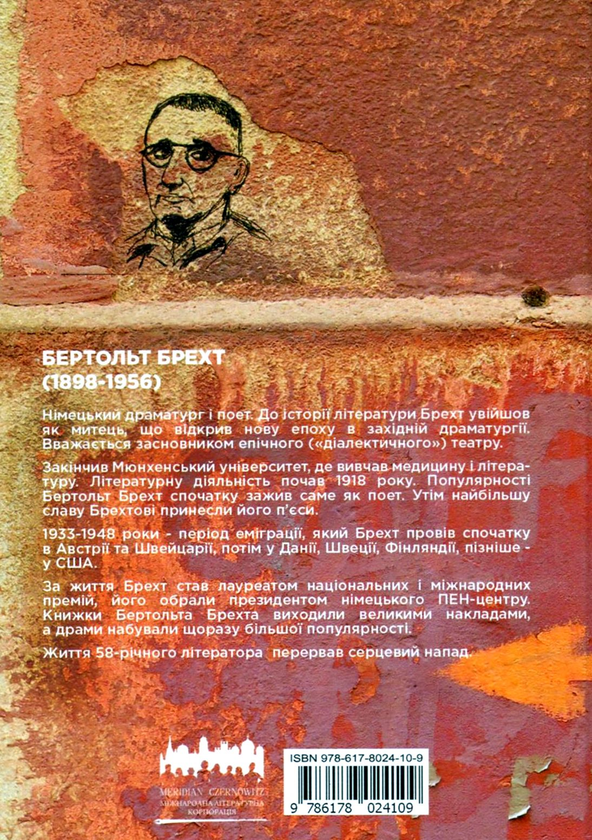
The book's artwork and cover feature photos from Serhiy Zhadan's personal archive, as well as his drawing by Bertolt Brecht.