This is an automatically translated description
Our sensory organs supply us with information about the world around us in a virtually continuous way. The brain analyses all these data and forms an opinion about what is true or false. However, unfortunately, human sight, taste and smell are not thoroughly analysed, and our mind interprets these perceptions in a subjective way. So in a completely orderly picture of the world can creep in, and you do not know whether to believe your own eyes or rely on other people's words? This dilemma can be solved by science, namely the scientific style of thinking.
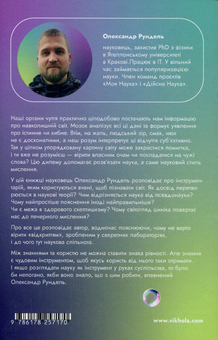
In this book, the scientist Oleksandr Rundel talks about the tools scientists use to understand the world. How is experience transformed into scientific theories? What is the difference between science and pseudoscience? Why is the simplest explanation sometimes the most correct? What are the limits of healthy scepticism? Why does the cynic's gaze turn us back to the liver's thinking?
The author explains why we should not believe "discoveries" made in secret laboratories, and why there is a scientific consensus.
It is impossible to put an equal sign between knowledge and corruption. But knowledge is a wonderful tool to get some benefit from it. And if we see science as a tool in the hands of society, it would be good if it knew what to do with it, Oleksandr Rundel believes.