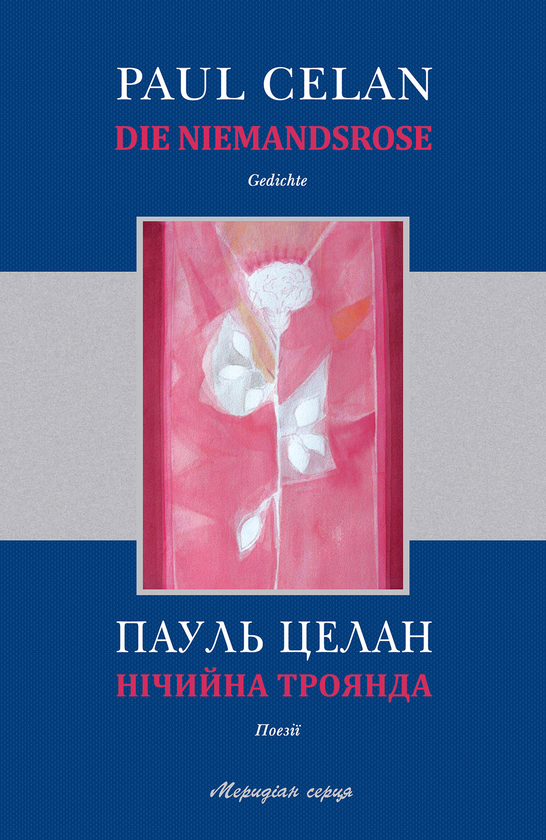

Book The No-One's-Rose
This is an automatically translated description
The collection Nobody's Rose is central to Celan's poetic oeuvre and is considered the pinnacle of his work. It covers poems written between 1959 and 1963. Like The Linguistic Grid, it contains a clearly expressed poetological programme, which is also a project of being. The construction of a new reality involves existential questions and issues of cultural identity, especially the suffering caused by the Holocaust, and the discovery of Russian literature, which was embodied for him by the Russian-Jewish poet Osip Mandelstam. The cosmic dimensions of Celan's universe are expressed, among other things, in numerous intertextual connections that show him to be an extremely open-minded poet.
No Man's Rose is […]a search for the absolute poetic book, which at the same time should be the absolute archival book. In this sense, Celan has "consistently thought to the end of Mallarmé," as he claims in his Meridian speech. With his text, he encourages the reader to set out on the journey himself, to take his own steps. His poems are not written to be repeated after him - reconstructing their meaning is not enough - but to teach us a new language. They seek to lead the reader on this path.
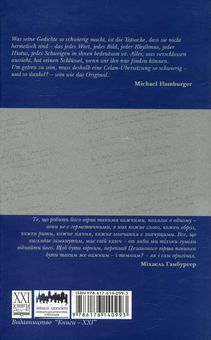
Bernd Witte What makes his poems so difficult is one thing – they are not hermetic, in them every word, every image, every rhythm, every sigh, every silence is significant. Everything that looks locked has a key - if only we could find it. To be faithful, a translation of Caelan's poem must be as difficult - and dark - as the original itself. Michael Hamburger Celan's poems are translations. They translate the language of others into his own language, perhaps even into his own foreignness. His poems are ways of reading the world, all in the creative process of writing. They translate the quick, false intimacy of German (which is also the language of murderers for him) into the foreignness of the poem, into a language in which and from a distance from which breathing is possible. Klaus Foswinkel