This is an automatically translated description
In the twentieth century, American political scientist Zbigniew Brzezinski repeatedly emphasised that without Ukraine, Russia ceases to be an empire, and if Ukraine joins, the Russian Empire, like a phoenix, will always be reborn. This is the main reason for Russia's war against Ukraine in 2014. And it is also the reason for its "phantom pain" every time this Eurasian empire loses Ukraine, because without it, it is gradually turning into an Asian Muscovy. Hence, the denial of the facts of history, state propaganda about the "single Russian people, common history and state". And most importantly, the denial of Ukraine's right to its own statehood, territory, natural and human resources, because the success of building a European form of democracy in Ukraine is a threat to Russia's authoritarian Asian form of governance. All this once again shows: "the fate of not only Europe, but the whole world will again depend on the fate of Ukraine."
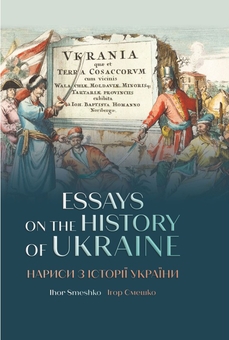
Russian propaganda is trying to justify the full-scale invasion of Ukraine, the annexation of Ukrainian territories, the genocide of the Ukrainian people and the destruction of the Ukrainian nation by distorting historical facts. That is why history is becoming a critical field for the information war against Russian propaganda and agitation, and the book Essays on the History of Ukraine is a powerful argument for it.
In Essays on the History of Ukraine, Ihor Smeshko debunks Russia's attempts to appropriate the name and history of Kyivan Rus, as well as the main myths of Putin's propaganda about the "one nation", "sacredness of Crimea", etc. The author uses historical examples to demonstrate that Ukraine and Russia have developed along very different civilisational vectors - cultural, linguistic, legal, and institutional.
In addition, based on a thorough historical research, the author provides answers to extremely important questions of our time: What is the building of modern European civilisation? On what foundation is it built? And most importantly, have the components of this civilisation been present on the territory of modern Ukraine since ancient times?
In Essays, Ihor Smeshko also describes in detail what modern Ukraine is, and gives a convincing answer to the question of whether Ukrainians are Europeans or Eurasians in terms of their origin, culture, and desire for further development.
A separate section of the book is devoted to the vision of the modern national idea of Ukraine and the author's formulation of three basic laws of democracy building in any country in the world. This may become a further strategy for the development of a powerful, self-sufficient, economically developed and militarily strong Ukraine in the 21st century.