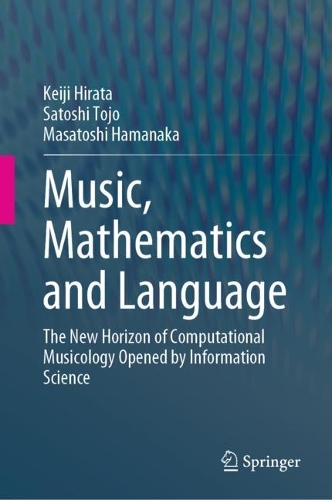
Book Music, Mathematics and Language: The New Horizon of Computational Musicology Opened by Information Science
Product code: 20370060
Format
Book language
Publisher
Year of publication
Category
Music Foundations of mathematics. Number theory. Mathematical logic Applied mathematics Cybernetics. Artificial intelligence Семіотика, когнітивна наука та інші дослідження Aesthetics General and applied linguistics Theory of music and musicology Computational and corpus linguistics Semiotics / semiology Mathematical foundations Applied mathematics Artificial intelligence
About book
This book presents a new approach to computational musicology in which music becomes a computational entity based on human cognition, allowing us to calculate music like numbers. Does music have semantics? Can the meaning of music be revealed using symbols and described using language? The authors seek to answer these questions in order to reveal the essence of music.
Chapter 1 addresses a very fundamental point, the meaning of music, while referring to semiotics, gestalt, Schenkerian analysis and cognitive reality. Chapter 2 considers why the 12-tone equal temperament came to be prevalent. This chapter serves as an introduction to the mathematical definition of harmony, which concerns the ratios of frequency in tonic waves. Chapter 3, “Music and Language,” explains the fundamentals of grammar theory and the compositionality principle, which states that the semantics of a sentence can be composed in parallel to its syntactic structure. In turn, Chapter 4 explains the most prevalent score notation – the Berklee method, which originated at the Berklee School of Music in Boston – from a different point of view, namely, symbolic computation based on music theory. Chapters 5 and 6 introduce readers to two important theories, the implication-realization model and generative theory of tonal music (GTTM), and explain the essence of these theories, also from a computational standpoint. The authors seek to reinterpret these theories, aiming at their formalization and implementation on a computer. Chapter 7 presents the outcomes of this attempt, describing the framework that the authors have developed, in which music is formalized and becomes computable. Chapters 8 and 9 are devoted to GTTM analyzers and the applications of GTTM. Lastly, Chapter 10 discusses the future of music in connection with computation and artificial intelligence.This book is intended both for general readers who are interested in music, and scientists whose research focuses onmusic information processing. In order to make the content as accessible as possible, each chapter is self-contained.
Details
Publisher
Number of pages
257
Published
2022
Language
English
Illustrations
Not illustrated
Book type
Printed
Binding
Hardcover
Weight
626
ISBN
9789811951657
Dimensions
155x235 мм
Compare size
Code
20370060
Reviews