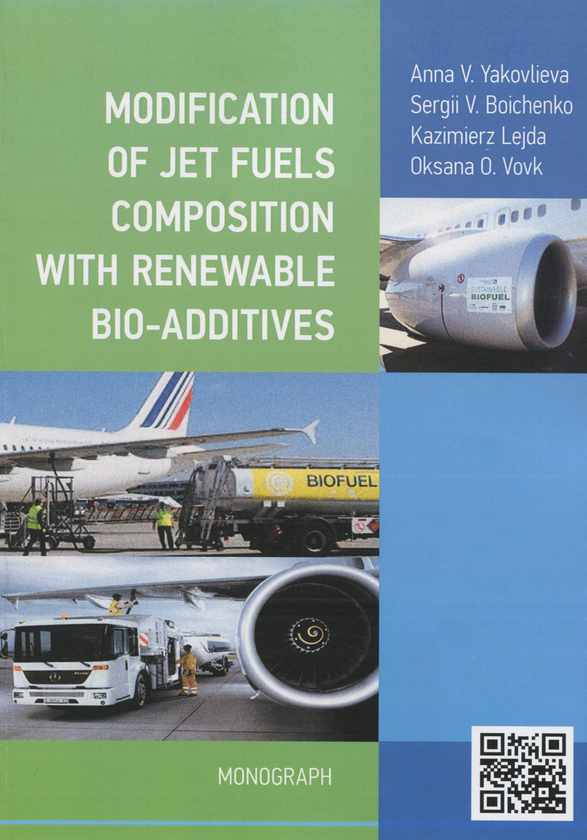


Book Modification of jet fuels composition with renewable bio-additives
This is an automatically translated description
The study is devoted to developing of alternative jet fuel by means of blending conventional jet fuel with plant-derived bio-additives and studying properties of new alternative jet fuels. The review and systematisation of the variety and classification of jet fuels used all over the world was done. The technologies of jet fuels production from various non-renewable energy sources are discussed. Factors that stipulate the development and implementation of alternative jet fuels were shown: limitation of crude-oil deposits, decreasing of its energy efficiency, global warming that is intensified by processes of extraction, processing and use of fuels and exhaust gases that negatively affect the atmosphere. Perspective technologies and feedstocks for alternative jet fuels production were analysed, as well as the advantages and disadvantages of each of them. Fundamentals of jet engine operation and exploitation are considered within this study. It was discussed how jet fuels quality and composition can affect the life span, reliability and durability of jet engines. The method for bio-additives production from rapeseed oil and camelina oil fatty acids esters was developed. High quality bio-additives based on FAME and FAEE of rapeseed and camelina oil were used for blending with conventional jet fuels. In the result of experimental studies, the comparative characteristics of physical-chemical and exploitation properties of new alternative jet fuels were developed. The properties of new jet fuels were considered for satisfying the requirements of standards for fuels of grade Jet A-1. It was shown that the maximum content of bio-additives in blended jet fuels is 30 %. As a result of bench tests, it was concluded that the operational parameters of the jet engine powered with new blended jet fuels fully satisfy the exploitation norms that are set in the specification for the tested jet engine, can be used as a working body of the jet engine and do not require its design changes. In the result of the emissions evaluation it was concluded that blending conventional jet fuels with bio-additives allows improving its environmental properties: reducing amounts of CO2, H2O, SO2 and NOx emissions in jet engine exhaust gases. The results of the study will contribute to reducing the energy dependence of air transport, improve its environmental friendliness and will promote improvement of the sustainability and safety of modern civil aviation.