This is an automatically translated description
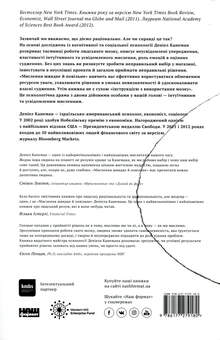
The book Thinking Fast and Slow by psychologist and economist Daniel Kahneman became a New York Times and Amazon bestseller, and was named Book of the Year by the New York Times Book Review, The Economist, The Wall Street Journal, and Globe and Mail (2011) and winner of the National Academy of Sciences Best Book Award (2012).
Topic
Psychology, behavioural economics, neuroeconomics, marketing, sociology, self-education, personal development.
About the book
We usually believe that we act rationally. But is it really true? Based on research in cognitive and social psychology, Daniel Kahneman reveals the secrets of the human brain, describes unconscious biases, the properties of intuitive and conscious thinking, and the role of emotions in value judgements. Without this knowledge, you risk making the wrong choice in the store, investing in unsuccessful projects, and generally making the wrong decisions. Thinking Fast and Slow will teach you how to use your limited attention span effectively, make decisions under uncertainty, and improve your judgement. However, the book is not a dry manual on how to use your brain. It's a psychological drama with two protagonists in your head - intuitive and conscious thinking.
Who is the book for
For the widest range of readers; for those who want to understand the behaviour of the brain in the decision-making process and learn to recognise their own mistakes and biases; for those interested in marketing and behavioural economics.
Why this book
The book will teach you how to make the right decisions. Based on interesting research, it explains why we act irrationally and what influences our choices. It is a useful and valuable source for self-improvement.
About the author
Daniel Kahneman is an Israeli-American psychologist, economist, and sociologist. In 2002, he won the Nobel Prize in Economics. He was awarded one of the greatest honours of the United States - the Presidential Medal of Freedom. In 2011 and 2012, he was named one of the 50 most influential people in the financial world by Bloomberg Markets magazine.
Reviews of the book
«There have been many meaningful books about human rationality and irrationality, but there is only one masterpiece, and that is Daniel Kahneman's Thinking Fast and Slow. It is one of the most remarkable and interesting books about the human mind that I have ever read."
— William Easterly, Financial Times
«Daniel Kahneman is one of the most original and interesting thinkers of our time. No other person on the planet understands better than Kahneman how we make choices and why we make them. This simply amazing book is packed with valuable life wisdom, presented in an easy-to-understand, yet profound way. «Thinking Fast and Slow» is a must-read for every curious person.
— Stephen Levitt, co-author of Freakonomics and Think Like a Freak
«We should be grateful to Kahneman for giving us in this book a joyful insight into the practical side of our personalities.
— Freeman Dyson, The New York Review of Books
«Kahneman's work touches on a wide range of fields: it extends to education, business, marketing, politics . . and even happiness research. Call his field of study 'psychonomy', the hidden rationale behind our choices. Thinking Fast and Slow is essential reading for all thinking people."
— Kyle Smith, The New York Post
Quotes
On absolute certainty
It is wise to take seriously any confession of uncertainty, while statements of absolute certainty indicate that a person has built a coherent story in their mind that is not necessarily true.
About the means of influence
Frequent repetition is a reliable way to make people believe a lie, because it is not so easy to distinguish between truth and the feeling of something familiar. Authoritarian regimes and marketers have known this for a long time.
On outcome bias
We tend to blame someone for a good decision with a bad outcome, and if everything goes well, we don't feel the need to thank them for it. This is an example of outcome bias.
About secret thinking
…Consciousness notices only some activated ideas; the main part of the work of associative thinking takes place covertly, as if in secret from our conscious self. The idea of limited access to one's own mind is, of course, difficult to accept, because it does not correspond to our feelings. However, it's true: we know much less about ourselves than we think we do.
About self-control
If you worry too much about how you perform a task, the results of its implementation will be worse than when you don't, because your short-term memory will be occupied with unnecessary anxious thoughts. The conclusion is obvious: self-control requires both attention and effort.
About the role of the title
Shares with easier-to-pronounce abbreviations (e.g. KAR or LUNMOO) have been performing better than those with awkward acronyms (e.g. PXG or RDO), and they seem to be maintaining a slight advantage for some time. Investors expect higher returns from stocks with names that are easier to pronounce than from stocks with names that are too complicated.
About the risks
The emotional, cognitive and social factors that support over-optimism combine to form an explosive mix that sometimes leads people to take risks they might have avoided if they had known the odds. It's not that risk-takers in economics are more gamblers, it's just that they, unlike cautious people, don't notice the risks.