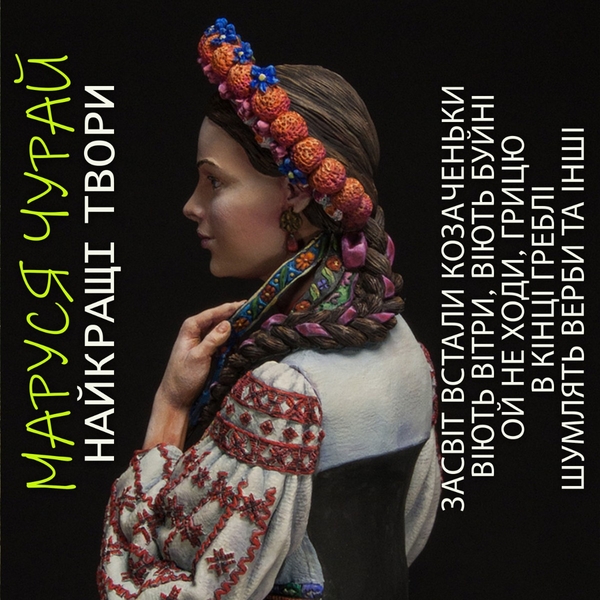
This is an automatically translated description
Marusya Churai (1625-1653) was a semi-legendary Ukrainian folk singer and poet from the Khmelnytskyi region, who, according to legend, lived in Poltava. She is credited with writing a number of popular songs: "Oh, don't go, Hrytsia", "Carts rolled down the mountain", "Cossacks whistled", etc.
According to legend, Marusia Churai was born in 1625 in the family of a Cossack centurion Hordii, one of the leaders of the anti-Polish uprising. After the death of her father, who was one of the elders during the Ostryanyn Uprising and was burned at the stake in Warsaw in 1638 as a rebel, she remained with her mother in Poltava. Their house stood on the bank of the Vorskla River, near the Holy Cross Monastery, which has been preserved to this day. In her youth, the girl had many suitors, including a young Cossack Ivan Iskra, but she gave her heart to Hrytsia Bobrenko (according to other versions, Hryts Ostapenko), the son of a Poltava regiment's chorunzha, with whom she later became secretly engaged. With the outbreak of the Khmelnytsky Revolt in 1648, Hryts went to war, promising to return. The girl waited for him for 4 years. However, when Hryts returned to Poltava, he no longer paid attention to Marusia because he fell in love with another woman, Hanna, from a wealthy Poltava family. The betrayed girl could not bear the loss and decided to poison herself with a potion she had secretly taken from a local witch, but which Hryts had accidentally drunk...
Content
At the end of the dam, the willows are noisy
In the garden, the hops are in bloom
Winds are blowing, winds are violent
Grytsya, Grytsya, to work
The Cossacks got up at dawn
The periwinkle was green
A nice garden was growing
The carts were rolling down the hill...
The eagle flies over the beam
The willow is abundant in the garden
Oh, don't go, Hrytsya...
A cuckoo came
A pigeon sits on the bank
Why is the water muddy?
Performer: Yevhen Kulyk
Duration: 14 minutes 35 seconds