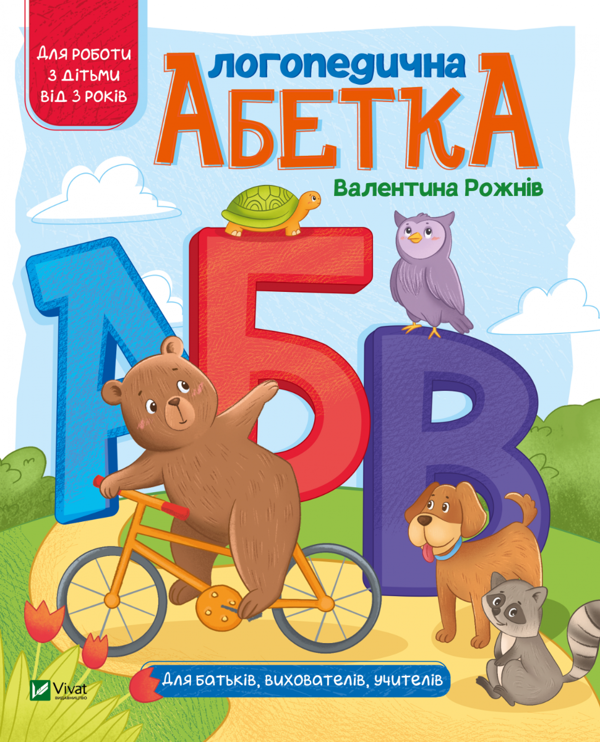
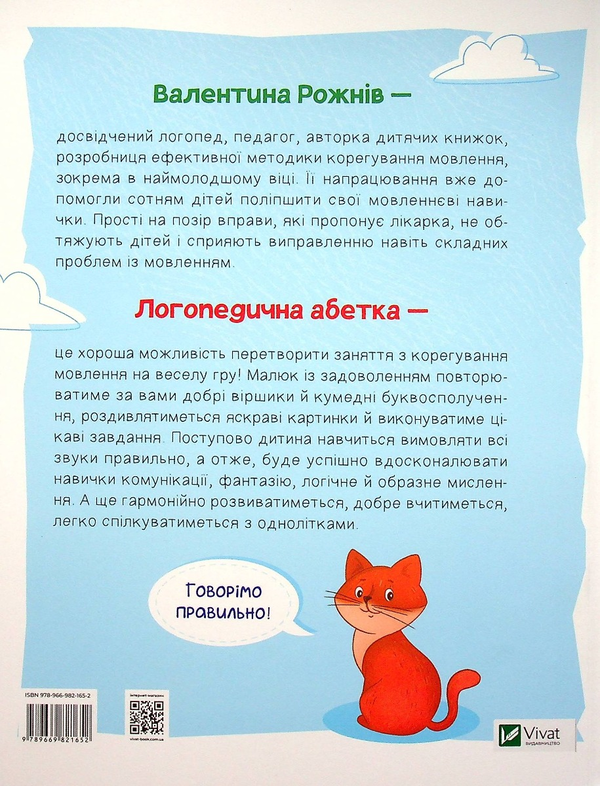

Book Speech therapy alphabet
This is an automatically translated description
The child is offered 7 types of work for each letter.
1. Disguised letters. At the top of the page there are pictures-associations. The child sees a word in which the first letter is a picture that is graphically similar to the letter itself. These are words that need not only to be read, but also to be looked at. This should interest even those children who do not like to study, and will arouse their interest in reading. Looking at such words, the child will develop imagination, fantasy, observation, and imaginative thinking.
2. Word pyramids. A pyramid of word pictures. The drawings are on the steps. A number of words are offered with an increasing number of syllables: on the first step there is a picture with only one syllable in its name, on the second step - a picture - a two-syllable word, on the third - a three-syllable word, on the fourth - a four-syllable word. In addition, the "small", one-syllable word on the first step is also small in size. As the word becomes larger (in syllables), the size of the picture increases. In this way, the child learns to perceive words by ear, and learns the concepts of "small" and "big" words. Since there are no monosyllabic words that begin with a vowel letter, in such cases the vowel letter itself will be on the first step.
3. Rhyming nursery rhymes. The adult reads small rhyming lines to the child, to which the child has to suggest the last, necessary word. This exercise teaches the child attentiveness, thinking, thoughtfulness, phonemic perception. The named word must begin with a given sound. This exercise activates auditory-visual intelligence, speech, thinking and trains memory, because the answer can be found among the pictures. This task can be printed in small print, as it is intended for adult reading.
4. Picture rhymes. A child who cannot read can read these rhymes. But with an adult. By naming pictures instead of the necessary words, the child thinks about the meaning of the text, learns to agree on the endings of words in gender, number, case. They learn to control and follow the rhythm and expressiveness of speech in the text.
5. Purity talks. It involves repeating the syllable and naming the picture, highlighting the desired syllable in the word with your voice. This is a very "logopedic" exercise that trains diction, speech expressiveness, automates the clear pronunciation of a sound in a word, trains the tempo, rhythm and intonation of speech. The child can repeat the proposed clean-up lines after an adult or read them independently. Reading the syllables independently, the child will train visual perception and memory, learn to merge letters into syllables, which will speed up the process of mastering literacy.
6. Picture sentences. This task continues to develop speech, train thoughtfulness and mindfulness skills. By saying picture words whose name begins with the desired letter (sound), the child will improve and consolidate phonemic processes, that is, learn to hear, recognise, and distinguish sounds in words, and not confuse sounds with similar sounds. Mastering the skills of sound-letter analysis is the main guarantee of literacy.
7. Chain: A ribbon or chain of various graphic symbols runs along the bottom line of the page or around the perimeter of the page, among which the child must find and highlight (circle, cross out, etc.) the desired letter. This exercise trains visual attention, visual perception, and visual memory. The child checks himself or herself to see if he or she has remembered, learnt, or learned a new letter.