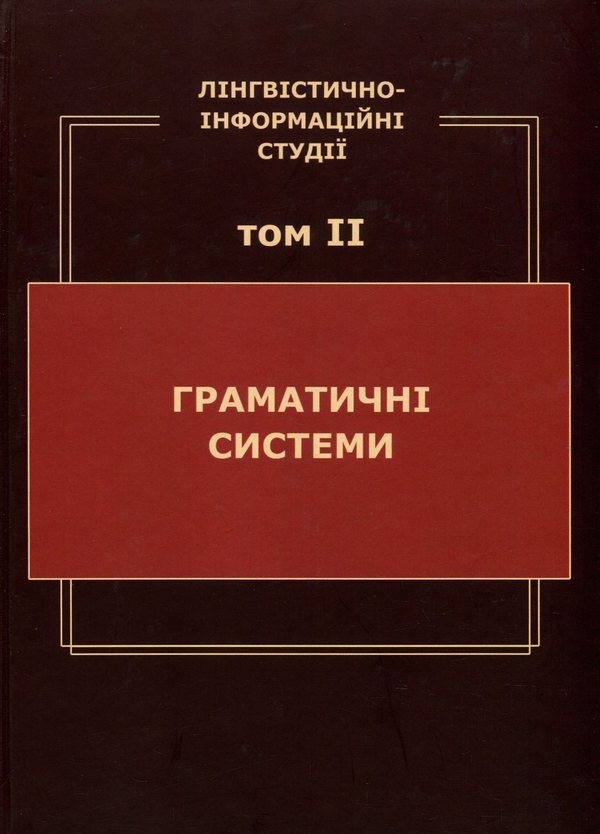

Book Linguistic information studios. In 5 volumes. Volume 2. Grammar systems
This is an automatically translated description
The second volume of the monograph «Grammatical systems» is devoted to the introduction of grammatical properties of a certain stake of languages, which is based on the formalism of the semantic states and the theory of lexicographic systems developed in the previous volume. The factorisation of the semantic state of a semantic unit into grammatical and lexical components is proposed. Analyses of grammatical statuses are carried out within the boundaries that leave the lexical part of the corresponding full semantic status unchanged. In this way, the number of grammatical aspects that constitute the subject matter is identified. In general, the research is concentrated on the word-emotional properties of language systems.
Formally identified the concept of word-phrase paradigm for flexive languages (with synthetic component in the word-phrase) – Ukrainian and Russian, as well as the concept of paradigmatic relation and paradigmatisation operator. The lexicographic word-formation systems for the above-mentioned languages have been created. The implementation of the above systems on large representative arrays of lexical data made it possible to create practically vichorny word-phrase classifications – Ukrainian and Russian, and also allowed to create virtual lexicographic laboratories. Analogous results were obtained for the languages with analitic-synthetic component in the word vocabulary – German and Spanish.
The study was carried out on the nominal word-formation of the current Turkish language, which belongs to the class of agglutinative. The general morphological structure of Turkish nominative lexemes was prepared. The theory of grammatical identification of noun forms as such forms, which are in the state of partial superposition (noun-divisive) of grammatical states, was created by using the formalism of semantic states. This approach allowed us to produce a fairly complete word-grammatical classification of Turkish nouns and the corresponding grammatical L-system. On the basis of the results obtained, a virtual lexicographic laboratory of Turkish nominative vocabulary has been created, which has been verified on an array of about 30 thousand lexemes (close to 60 million word forms).