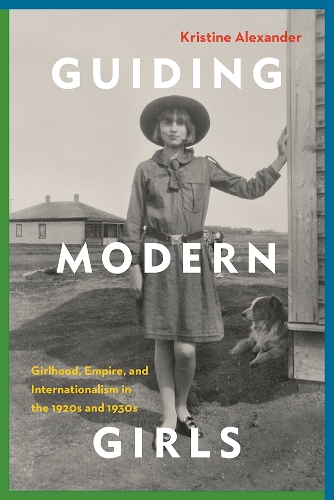
Across the British Empire and the world, the 1920s and 1930s were a time of unprecedented social and cultural change. Girls and young women were at the heart of many of these shifts, which included the aftermath of the First World War, the enfranchisement of women, and the rise of the flapper or “Modern Girl.” Out of this milieu, the Girl Guide movement emerged as a response to popular concerns about age, gender, race, class, and social instability.
The British-based Guide movement attracted more than a million members in over forty countries during the interwar years. Its success, however, was neither simple nor straightforward. Using an innovative multi-sited approach, Kristine Alexander digs deeper to analyze the ways in which Guiding sought to mold young people in England, Canada, and India. She weaves together a fascinating account that connects the histories of girlhood, internationalism, and empire, while asking how girls and young women understood and responded to Guiding’s attempts to lead them toward a service-oriented, “useful” feminine future.
"
Guiding Modern Girls unveils how the early Girl Guide movement carved out spaces of intergenerational female homosociality that were neither fully empowering nor exclusively oppressive. On a larger scale, it gestures at the untapped potential buried in the history of youth organizations for charting the stony and serpentine trails that led to the emergence of a global modernity.
" - H-SOZ-KULT
"
Kristine Alexander makes a significant contribution to the intertwined histories of girlhood, imperialism, and the international Girl Guide movement.
" - Canadian Historical Review
"
Alexander paints a complex image of the organization, which was the epitome of the simultaneously dynamic and traditional nature of British society in the interwar period, and makes a significant contribution to our understanding of the Girl Guides through this thought-provoking transnational study.
" - Historical Studies in Education, Vol. 31, No. 1