This is an automatically translated description
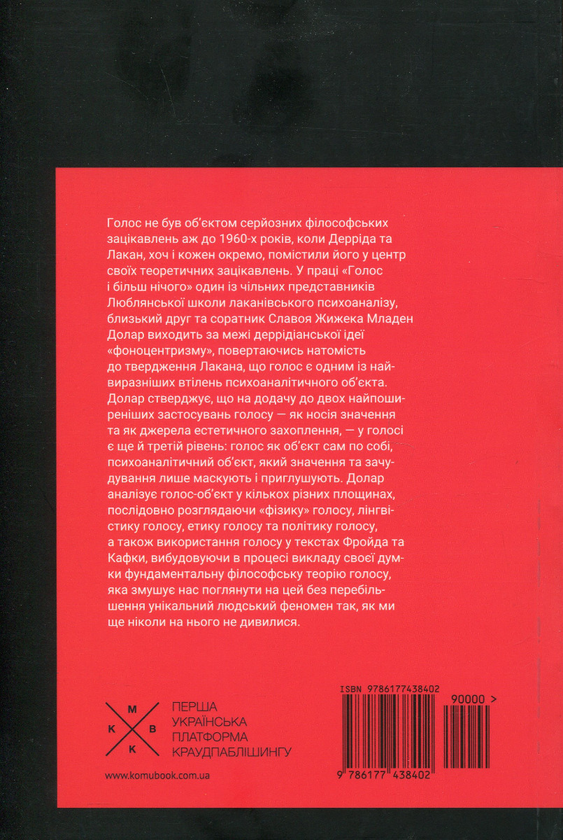
The voice was not an object of serious philosophical interest until the 1960s, when Derrida and Lacan, albeit individually, placed it at the centre of their theoretical concerns. In The Voice and Nothing Else, one of the leading representatives of the Ljubljana School of Lacanian psychoanalysis, a close friend and associate of Slavoj Žižek, Mladen Dolar, goes beyond Derrida's idea of "phonocentrism", returning instead to Lacan's claim that the voice is one of the most expressive embodiments of the psychoanalytic object. Dollar argues that in addition to the two most common uses of the voice-as a carrier of meaning and as a source of aesthetic delight-there is a third level to the voice: the voice as an object in itself, a psychoanalytic object that meaning and delight only mask and mute. Dollar analyses the voice-object from several different perspectives, successively examining the "physics" of the voice, the linguistics of the voice, the ethics of the voice, and the politics of the voice, as well as the use of the voice in the texts of Freud and Kafka, building in the process a fundamental philosophical theory of the voice that forces us to look at this uniquely human phenomenon in a way we have never looked at it before.