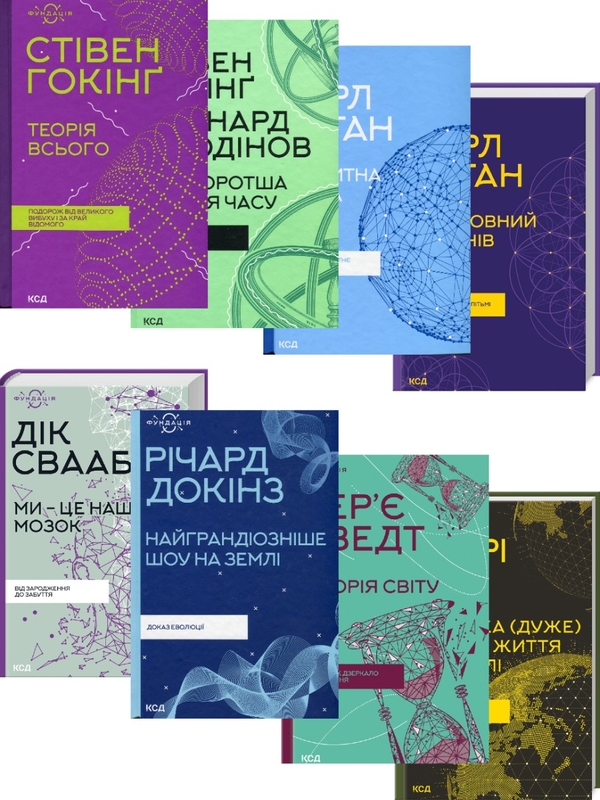
Book Foundation (8 Books Collection Set)
This is an automatically translated description
Book 1: The Theory of Everything
Everything is what surrounds us. What we are a part of. Time and space, celestial bodies and galactic abysses. This is everything. But how did it come to be? How did it all begin? And how will it end? The brilliant Stephen Hawking explores deep questions and finds even deeper answers. The search for primordial black holes and the hot Big Bang model, quantum gravity and arrows of time, the boundary conditions of the Universe and Friedman models. The book reveals the idea of the Universe from the postulate that the Earth is shaped like a sphere to the theory of the expansion of the Universe based on the most modern research. The seven lectures, covering a wide range of topics, are a real triumph of the human mind. Hawking came closer to the secret of the very essence of creation. And he was able to look even further - into the black, extra-dimensional heart of the Universe...
Book 2. The Shortest History of Time
Stephen Hawking is called a modern-day Einstein for his scientific works on cosmology and theoretical physics. A professor at Cambridge University and a brilliant scientist, he has done more than anyone else to popularise modern science. Together with the American physicist and mathematician Leonard Mlodinow, he created The Shortest History of Time, which was first published in 1988 and was on the bestseller list of The Sunday Times for four years in a row. Over the next 20 years, the book has been published in 10 million copies, translated into 35 languages, rewritten in the spirit of new discoveries, and is still gaining more and more enthusiastic readers today.
Humanity has gathered a wealth of knowledge about space, using super-fast computers and powerful telescopes to see the birth and death of distant stars. But when was the Universe itself born? What is the nature of time and did it exist before the Big Bang? Is it possible for it to run backwards and are dreams of time travel so fantastic?
Explaining the essence of the most complex scientific theories in a clear language using a single formula is a task that only Stephen Hawking can do. But he leaves the main question open...
And the main question is...
Book 3. The Blue Dot. The Space Future of Humanity
Space is an unexplored mysterious space. And mankind has always sought to discover and travel. When we explored the Earth like the back of our hand, we naturally looked up at the starry sky above our heads. And there was a new Ocean, the depths of space, other galaxies. And the space odyssey began... Exploration of planets and satellites, robotic missions and expeditions, Voyager and Apollo, "space neighbours", unknown nebulae and constellation secrets, ships on the edge of the solar system and what is beyond. "The Blue Dot is a book about how we need to look at ourselves again, at our place in the universe, and how, even as the call of the unknown has become quieter and less distinct, the central element of the human future lies far beyond the boundaries of the globe.
Book 4. A world full of demons. Science as a Candle in the Darkness
This book is a manifesto of science. In it, Sagan summarises his colossal scientific experience. The scientist shatters pseudoscientific myths. The facts, supported by ironclad logical arguments, refute the false scientific theories that have long been passed off as serious research. Sagan teaches the reader to think critically and not to forget about common sense. The book, as the author himself defines it, is the best guide to unmasking the fake scientific truths to which he contrasts real discoveries.
Book 5. The Greatest Show on Earth: The Proof of Evolution
Evolution is accepted as a scientific fact by all reputable scientists. But why do millions of people still doubt the truth of this theory, and why are creationists who deny evolution growing in number?
Richard Dawkins, armed with a strong shield of convincing arguments and a spear of bare logic, enters the arena to begin the greatest show on Earth - the great and beautiful Evolution. Starting with examples of natural selection and the emergence of new species, from plate tectonics to molecular genetics, and stacking the facts one by one, he creates an irrefutable case. He brilliantly proves that we, humanity, are an inflorescence on one of the branches of the sprawling tree of life with deep roots that did not appear out of nowhere. Just like you and me.
According to the scientist himself, this book is his personal synopsis of the evidence to prove that the theory of evolution is in fact a fact, as irrefutable as any other scientific fact.
Dick Swaab shatters the basic tenets of philosophers, religious leaders and political propagandists, proving that a person, his or her character, inclinations, sexual orientation are formed in the womb under the influence of genes and the environment and cannot be forcibly changed, corrected or cured later, and that "free will" is as nonsense as faith. The only thing that controls a person is his or her brain. Tracing a human life from birth to death, Dick Swaab will try to answer difficult questions
Can a mother during pregnancy influence the future of her child through her own behaviour and habits, and can a child influence the course of childbirth? Book 7. The History of the World. The Past as a Mirror of the Present Writing about history in today's troubled world is a very risky thing. One can fall into the trap of uncritically repeating outdated postulates or become a biased interpreter of history to suit the political, economic, cultural, and ideological trends of our time.
To avoid these pitfalls, Professor Terje Tweddt suggests looking at the past as if it were a mirror. Instead of interpreting historical events from the perspective of the present or the views on history that are still widespread today, he suggests showing how the events of the past - the rise and fall of civilisations, empires, and nations - and their perception in different periods influenced the formation of the world as it is today.
- The first civilisations: Sumer, Ancient Egypt, Indian civilisation - The industrial development of Europe and European colonialism - US dominance and the resurgence of China - Climate change shaping the future of the world Book 8: A Short (Very) History of Life on Earth Once upon a time (so long ago that it is almost unimaginable for a person to imagine it), a giant star died. It exploded, releasing energy. It lit up the entire space around it. And a supernova was created. Any life that could have existed in the planetary system of the old star died. However, nothing disappears without a trace: from the death of the ancient star, a new one was born - our Sun... British palaeontologist and evolutionary biologist Henry Gee takes you on a 4.6 billion-year journey that he has compacted into 12 chapters in this book.
- The formation of the Sun and the birth of the Solar System
At what age can we notice sexually determined differences in the behaviour of boys and girls and what shapes sexual orientation?
- Empires of the East: Chinese and Ottoman