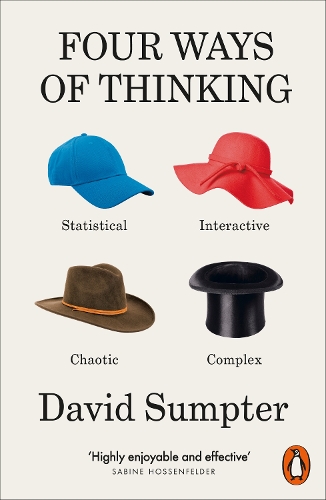
Book Four Ways of Thinking: Statistical, Interactive, Chaotic and Complex
'Packed with practical examples and insightful wisdom. . . A highly enjoyable and effective guide to better thinking' Sabine Hossenfelder
'I wish David Sumpter had been my maths teacher. I hated the subject at school. I hoover up his books now' Sunday Times
Acclaimed mathematician David Sumpter shows how we can deal with the chaos and complexity of our lives
What is the best way to think about the world? How often do we consider how our own thinking might impact the way we approach our daily decisions? Could it help or hinder our relationships, our careers, or even our health?
Thinking about thinking is something we rarely do, yet it is something science questions all the time. David Sumpter has spent decades studying what we could all learn from the mindsets of scientists, and Four Ways of Thinking is the result. Here he reveals the four easily applied approaches to our problems: statistical, interactive, chaotic and complex.
Combining engaging personal experience with practical advice and inspiring tales of ground-breaking scientific pioneers (with a tiny bit of number crunching along the way), Sumpter explains how these tried and tested methods can help us with every conundrum, from how to bicker less with our partners to pitching to a tough crowd - and in doing so change our lives.
"I wish David Sumpter had been my maths teacher. I hated the subject at school. I hoover up his books now. . . He unpicks four big 20th-century ideas, all related to mathematical modelling of real-world behaviour. His particular genius is to apply these ways of thinking to relatable situations" - The Sunday Times
"A mathematician tries to make sense of the world through different lenses in this surprisingly original book. . . Eccentrically fascinating and enjoyable" - Guardian
"Four Ways of Thinking by mathematician David Sumpter shows numbers illuminating human complexities… positing that all phenomena are, mathematically speaking, either stable, periodic, chaotic or complex. Learn the differences between these phenomena, and you are halfway to better understanding your own life … gripping" - New Scientist