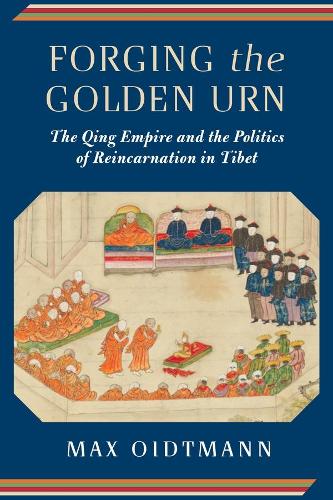
Book Forging the Golden Urn: The Qing Empire and the Politics of Reincarnation in Tibet
In 1995, the People’s Republic of China resurrected a Qing-era law mandating that the reincarnations of prominent Tibetan Buddhist monks be identified by drawing lots from a golden urn. The Chinese Communist Party hoped to limit the ability of the Dalai Lama and the Tibetan government-in-exile to independently identify reincarnations. In so doing, they elevated a long-forgotten ceremony into a controversial symbol of Chinese sovereignty in Tibet.
In Forging the Golden Urn, Max Oidtmann ventures into the polyglot world of the Qing empire in search of the origins of the golden urn tradition. He seeks to understand the relationship between the Qing state and its most powerful partner in Inner Asia—the Geluk school of Tibetan Buddhism. Why did the Qianlong emperor invent the golden urn lottery in 1792? What ability did the Qing state have to alter Tibetan religious and political traditions? What did this law mean to Qing rulers, their advisors, and Tibetan Buddhists? Working with both the Manchu-language archives of the empire’s colonial bureaucracy and the chronicles of Tibetan elites, Oidtmann traces how a Chinese bureaucratic technology—a lottery for assigning administrative posts—was exported to the Tibetan and Mongolian regions of the Qing empire and transformed into a ritual for identifying and authenticating reincarnations. Forging the Golden Urn sheds new light on how the empire’s frontier officers grappled with matters of sovereignty, faith, and law and reveals the role that Tibetan elites played in the production of new religious traditions in the context of Qing rule.
"[Oidtmann’s] work is marked by an exemplary scholarly discipline. . . . What he brings to the table is an extensive insight into the thinking and debates over the Golden Urn’s introduction among the Manchu authorities, and most particularly those of the aging Qianlong emperor (1711–99) himself." - Journal of Asian Studies
"An absorbing read for non-specialists." - Asian Review of Books
"Sheds a thoroughly new light on Sino-Tibetan relations against the backdrop of Qing colonialism." - Bulletin of the School of Oriental and African Studies
"Max Oidtmann’s tour de force is in introducing the reader to the mysteries of both Manchu and Tibetan powers. [He] offers a remarkable and finely crafted study." - Inner Asia
"Meticulously researched and skillfully argued." - Journal of Chinese History
"Oidtmann’s eloquent and learned book is thus essential reading for anyone who wants to understand the Qing political order." - Modern Chinese Literature and Culture
"[Forging the Golden Urn] serves as an outstanding model for how to avoid the anachronisms that tend to haunt the historical study of matters mired in contemporary polemics." - Journal of Chinese Religions
"It is not insignificant that Oidtmann’s story brings together the disparate literary and cultural studies of Tibet and Qing China in an accessible and tidy monograph." - Religious Studies Review
"The most comprehensive examination of the Golden Urn question to-date." - Bitter Winter
"Not only does Max Oidtmann do an excellent job providing a captivating account of a famed religious implement in an imperial context, he also opens a valuable window on how Tibet existed as part of an empire during that time." - Reading Religion
"The relationship between Qing China and Tibetan elites is explored in this fascinating work based on Manchu, Tibetan, and Chinese sources." - Choice
"The book is a must-read for anyone interested in Qing-Tibet relations" - Saksaha
"An excellent and much-needed contribution to our knowledge of the politics of the Qing empire in Tibet. . . . A must-read not only for the historian of Tibet, but for anyone who wants to better understand the current Tibet-China conflict." - Chinese Historical Review
"An immensely valuable work in the studies of Qing imperialism in Tibet." - China Review International
"A deeply researched account of the politics of reincarnation...all nicely framed by an introduction and conclusion that draw out the larger significance of the politics of the urn in Inner Asia and beyond." - Harvard Journal of Asiatic Studies