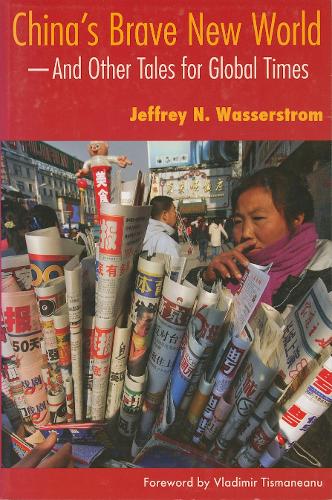
Provocative insights into China, travel, and technology in the 21st century
If Chairman Mao came back to life today, what would he think of Nanjing's bookstore, the Librairie Avant-Garde, where it is easier to find primers on Michel Foucault's philosophy than copies of the Little Red Book? What does it really mean to order a latte at Starbucks in Beijing? Is it possible that Aldous Huxley wrote a novel even more useful than Orwell's 1984 for making sense of post-Tiananmen China—or post-9/11 America?
In these often playful, always enlightening "tales," Jeffrey N. Wasserstrom poses these and other questions as he journeys from 19th-century China into the future, and from Shanghai to Chicago, St. Louis, and Budapest. He argues that simplistic views of China and Americanization found in most soundbite-driven media reports serve us poorly as we try to understand China's place in the current world order—or our own.
"
. . . readers will find themselves far more observant and attentive to local distinctions when they take their first or next trip to China.
" - The China Journal No. 60
"
China's Brave New World is a must-read for anyone interested in the world's most rapidly changing society. Wasserstrom explores China with an ethnographer's lens: he takes the reader into coffee shops, fast-food joints, red-chip firms, and bootleg video parlors—the kinds of places where with-it young Chinese spend their time. These are the stories that lie behind the 'economic miracle' of post-Mao/post-Teng China.
" - James L. Watson, Harvard University, editor of Golden Arches East: McDonald's in East Asia
"
. . . rather effortlessly brilliant . . . . It penetrates with a lightly knowing eye and ear into the interior mind, heart and soul of giant China and the innumerable Chinese.
" - AsiaMedia
"
. . . Recommended for medium-sized and larger libraries, as well as for the personal reading of librarians interested in China.
" - Library Journal